
Some HB 195 Votes are More Equal Than Others

HB 195 VOTES

SOME VOTES ARE MORE EQUAL THAN OTHERS

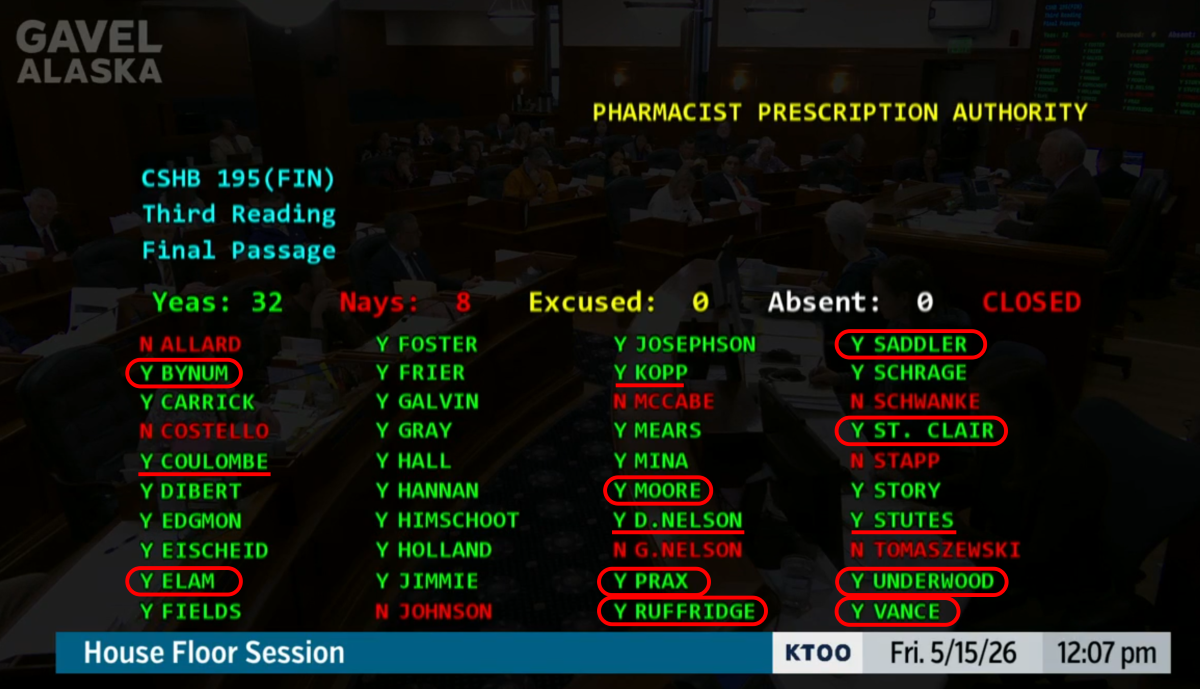
After the amendment fight, the public debate moved to final passage.

But final passage votes do not tell the whole story.

Some earlier votes mattered far more.

All votes are equal.

But some votes are more meaningful than others.

When we evaluate how legislators vote as a bill advances, some votes are more meaningful than others.

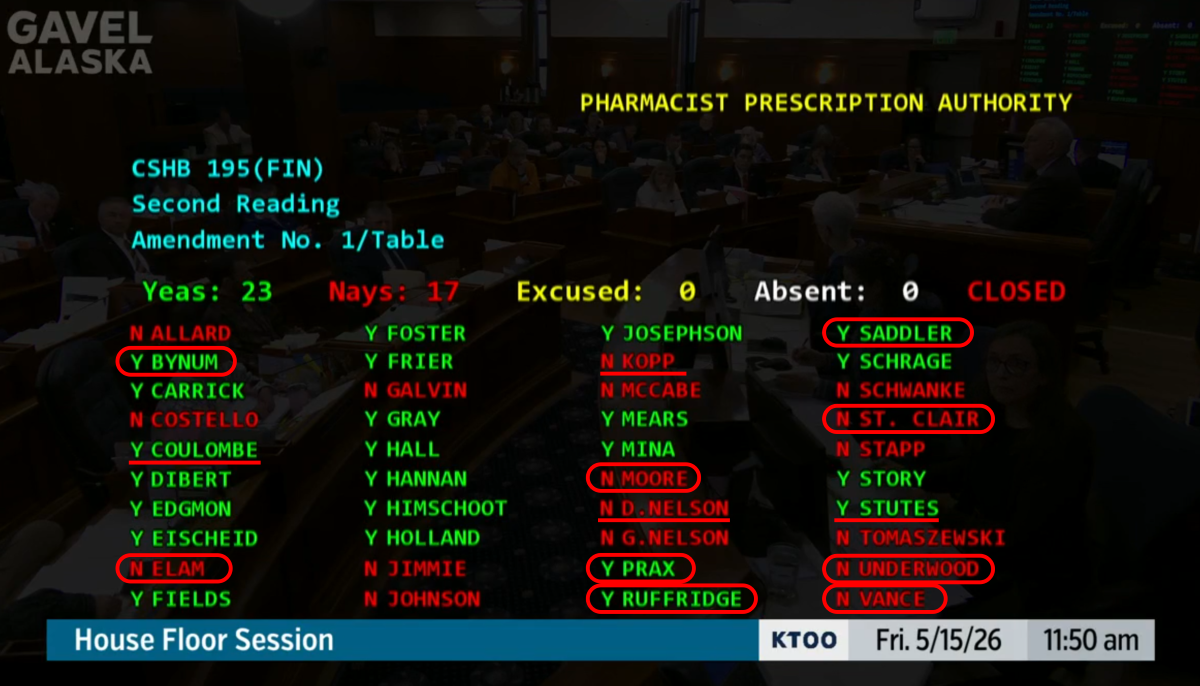
Voting against an amendment that would have prohibited abortion pills from being distributed in pharmacies is a far more meaningful vote than being one of 8 against 32 in the final bill passage vote.

Should Representatives Schwanke and Stapp get a pass for voting against final passage even though Schwanke voted to advance the bill on May 2, 2025?

Should Stapp get a pass even though he voted to kill pro-life Amendment #5 on May 11, 2026?

In summary, for those of us who want HB 195 defeated because it is an abortion pill expansion bill, the votes that matter most are these.

Blocking Allard’s pro-life amendment:

  • Representative Stapp.
  • Representative Moore.
  • Representative Bynum.

Representative Allard offered the same amendment on the House Floor again on May 15.

Bynum took the kill shot when he moved to table the amendment.

Voting with the abortion lobby to block Allard’s pro-life amendment were:

  • Representative Bynum.
  • Representative Prax.
  • Representative Ruffridge.
  • Representative Saddler.
  • Representative Stutes.

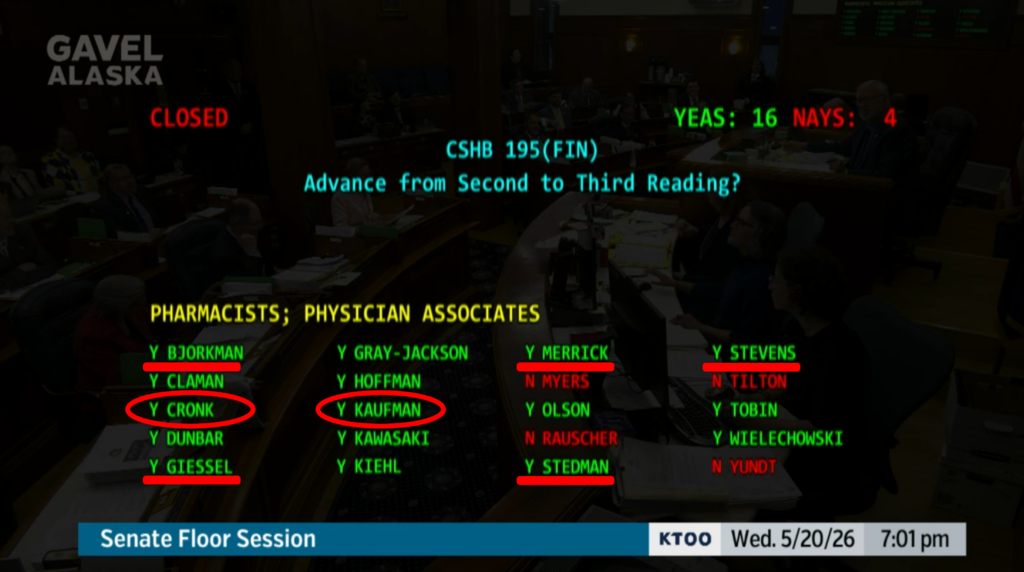
Giving the Democrats votes 15 and 16 needed to overcome the three-fourths threshold to advance to the easier 11-vote final passage were:

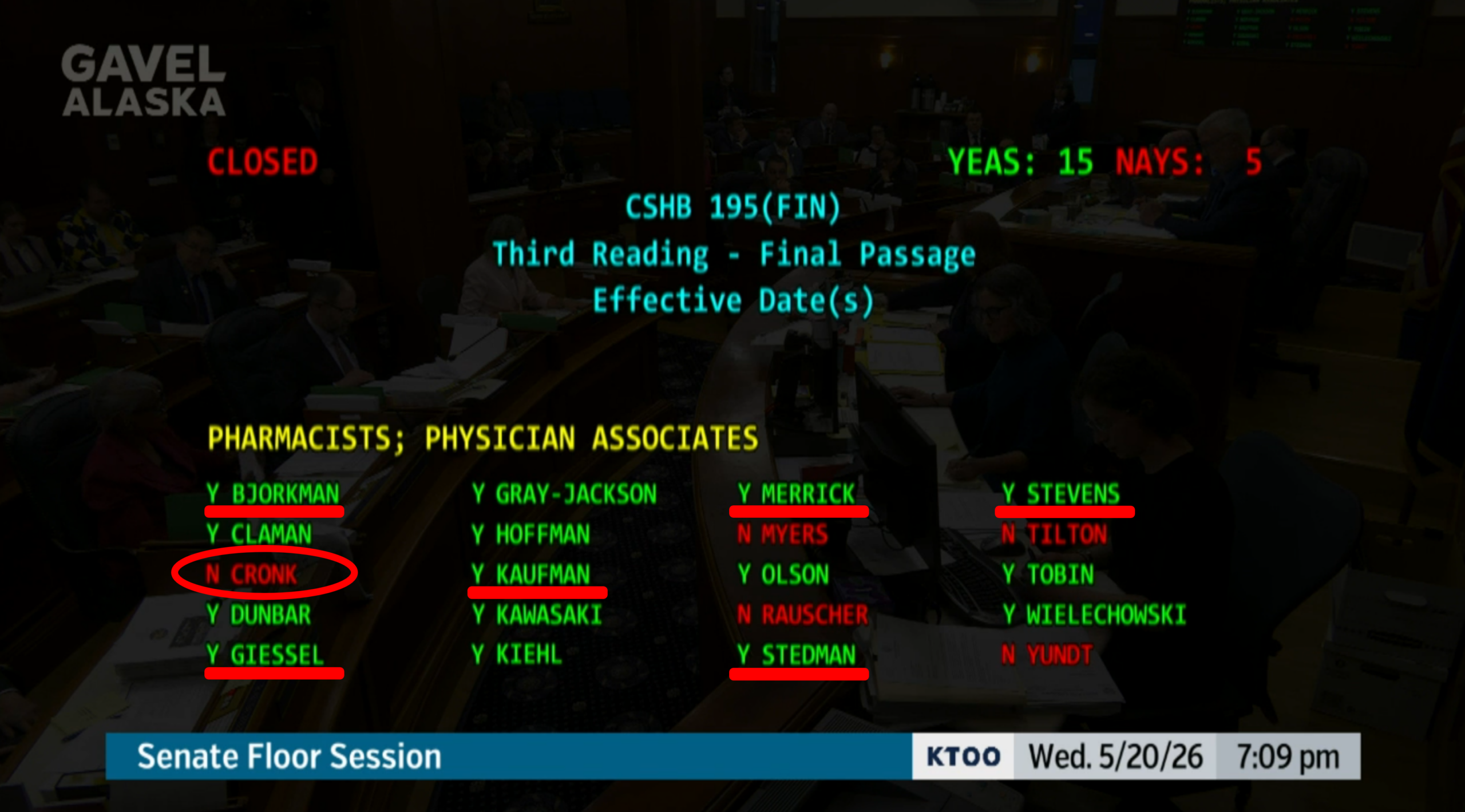
  • Senator Cronk.
  • Senator Kaufman.

Sadly, Republicans and conservatives — and even many pro-lifers — are quick to point out that Chuck Kopp, Louise Stutes, Jesse Bjorkman, and Cathy Giessel regularly caucus and vote with Democrats.

But just as many are equally quick to defend Republicans who block pro-life efforts or even advance the abortion lobby’s agenda.

We should expect more from our “pro-life” Republican representatives and senators.

And we should hold them accountable when they fail to live up to their “extremely, extremely pro-life” claims.


TEXT

TEXT

TEXT

QUESTIONS & CONTACT

Copyright © 2026 · Alaska Right To Life

How Cronk and Kaufman Hand Delivered HB 195

Cronk & Kaufman

Hand Deliver HB 195 to Abortion Lobby

Just days after the House passed HB 195, with only 12 hours remaining in the 34th Legislature, Senate Democrats needed a procedural vote to advance HB 195 from second to third reading.

Without that procedural vote, the bill would have died.

We would have already had our pro-life pizza party.

Advancing to third reading requires a three-fourths vote.

That means 15 votes advance the bill to a final passage vote, where only 11 votes are needed for final passage and sending the bill to the Governor’s desk.

When Senator Giessel made the motion to advance the bill to third reading, an objection was raised.

That moved the Senate to an immediate vote.

No discussion.

No debate.

But Giessel called for an at-ease.

The off-the-record wheeling and dealing started.

The Democrat Majority Caucus had the 11 votes to pass the bill.

But those 11 votes were meaningless if they did not have the 15 votes to advance immediately to third reading.

They had only one chance to get 15 votes for third reading.

If Giessel allowed the vote to happen without 15 votes, she would not get a second chance.

The bill would be defeated.

Tensions were high.

There was weeping and gnashing of teeth, tearing garments, and wearing sackcloth and ashes.

They came back later, and instead of returning to the vote — the only option on the table — Giessel tried again.

She asked for unanimous consent to advance HB 195 to third reading.

There was an objection.

Sackcloth tore.

Ashes flew.

Giessel called for another at-ease before the vote could be called.

The Senate went through this process twice on May 20.

At one point, Senate President Gary Stevens came down from on high to get the Senate back on track.

Why all the off-the-record debates and dealmaking?

Why all the off-the-record debates and dealmaking?

Because the Republican Minority Caucus had six members.

With six NAY votes, they could defeat HB 195.

We had them.

The bill was defeated.

As long as the Republican Minority voted as a block, HB 195 would fall in defeat.

I was drafting the celebration invitations, ordering pro-life pizzas, and all the non-alcoholic beer I could find.

But then Republican Minority Leader Mike Cronk and Republican James Kaufman broke from their caucus.

They crossed the aisle.

They voted with the Democrats.

They advanced the bill to the final passage vote.

The Democrats did not need Cronk and Kaufman to pass the bill – they had 14 votes – 3 more than the 11 needed to pass the bill after it reached the 3rd Reading.

But they needed 15 votes to get over the 3rd Reading hurdle.

Cronk and Kaufman delivered votes 15 and 16 to get over the 3rd Reading hurdle and advance to the Final Passage vote.

After hours of political theater, debating, closed-door and backroom dealing, Cronk and Kaufman left their caucus, crossed party lines, voted with the Democrats, and gave them the victory they so desperately wanted.

So when we count the votes, Cronk and Kaufman pulling defeat out of the jaws of victory are the votes that matter.

However Cronk and Kaufman voted on final passage, the Democrats had the 11 votes needed to pass the bill.

They could have gone back to the pub for drinks.

Their votes did not matter either way on final passage.

But Republicans Cronk and Kaufman cast the deciding votes that ultimately put HB 195 on Governor Dunleavy’s desk.

Hoping you wouldn’t notice – as many in the Republican Party and ‘conservative media’ have not, Cronk crossed back over and voted against HB 195 for final passage.

Remember: some votes are more equal than others – and had Cronk not crossed over for the 3rd Reading vote, there never would have been a Final Passage vote.

The Democrats did not need Cronk and Kaufman’s vote to reach 11 – they had 14 in the bag without Cronk and Kaufman.

The Democrats DID need Cronk and Kaufman’s votes to reach 15 on the 3rd Reading.

Governor Dunleavy must veto HB 195

more information

Get in the Fight HERE.

Call Governor Dunleavy: Veto HB 195 at (907) 465-3500

Get the FACTS about HB 195 HERE.

Read HB 195 HERE.

See the Official Legislative Record HERE.

QUESTIONS & CONTACT

Copyright © 2026 · Alaska Right To Life

PP v State 20240924

PP v. State of Alaska

Findings of Fact and Conclusions of Law

Case: Planned Parenthood Great Northwest, Hawai‘i, Alaska, Indiana, Kentucky v. State of Alaska, et al.

Case No.: 3AN-19-11710CI

Source: Uploaded PDF titled “Final Opinion PP v SOA 2024.” This desktop version renders the document as HTML text, not as embedded page images.

PDF Page 1Printed Page 1
Return to top ↑
PDF Page 2Printed Page 2
Return to top ↑
PDF Page 3Printed Page 3
Return to top ↑
PDF Page 4Printed Page 4
Return to top ↑
PDF Page 5Printed Page 5
Return to top ↑
PDF Page 6Printed Page 6
Return to top ↑
PDF Page 7Printed Page 7
Return to top ↑
PDF Page 8Printed Page 8
Return to top ↑
PDF Page 9Printed Page 9
Return to top ↑
PDF Page 10Printed Page 10
Return to top ↑
PDF Page 11Printed Page 11
Return to top ↑
PDF Page 12Printed Page 12
Return to top ↑
PDF Page 13Printed Page 13
Return to top ↑
PDF Page 14Printed Page 14
Return to top ↑
PDF Page 15Printed Page 15
Return to top ↑
PDF Page 16Printed Page 16
Return to top ↑
PDF Page 17Printed Page 17
Return to top ↑
PDF Page 18Printed Page 18
Return to top ↑
PDF Page 19Printed Page 19
Return to top ↑
PDF Page 20Printed Page 20
Return to top ↑
PDF Page 21Printed Page 21
Return to top ↑
PDF Page 22Printed Page 22
Return to top ↑
PDF Page 23Printed Page 23
Return to top ↑
PDF Page 24Printed Page 24
Return to top ↑
PDF Page 25Printed Page 25
Return to top ↑
PDF Page 26Printed Page 26
Return to top ↑
PDF Page 27Printed Page 27
Return to top ↑

Superior Court Opinion 2024

Findings of Fact and Conclusions of Law

Case: Planned Parenthood Great Northwest, Hawai‘i, Alaska, Indiana, Kentucky v. State of Alaska; et al.

Court: Superior Court for the State of Alaska, Third Judicial District at Anchorage

Case No.: 3AN-19-11710CI

Mobile version: No table of comments included. Page 2 contains the only approved highlighted passage.

Yellow highlight with red underline marks the approved highlighted text from page 2. The source opinion does not include separate printed legal line numbers; the narrow left guide numbers the mobile text rows for easier reference.

PDF Page 1Printed Page 1
IN THE SUPERIOR COURT FOR THE STATE OF ALASKA
THIRD JUDICIAL DISTRICT AT ANCHORAGE
Planned Parenthood Great Northwest, )
Hawai‘i, Alaska, Indiana, Kentucky, )
)
Plaintiff, )
v. )
)
State of Alaska; et al., )
)
_ _ _ _ _ _Defe_ndan_ts. _ )
) Case No. 3AN-19-11710CI
FINDINGS OF FACT AND CONCLUSIONS OF LAW
Introduction
Plaintiff Planned Parenthood Great Northwest, Hawai‘i, Alaska, Indiana, Kentucky (Planned
Parenthood) filed this lawsuit challenging AS 18.16.010(a)(1), which prohibits anyone other than a
licensed physician from providing abortions. Planned Parenthood argues that applying the restriction
to otherwise qualified physician assistants and advanced practice registered nurses violates Article I,
section one of the Alaska Constitution, which protects the right to equal protection, and Article I,
section 22 of the Alaska Constitution, which protects the right to privacy. Planned Parenthood asks
the court to enjoin the prohibition on these advance practitioner clinicians from performing first
trimester medication abortion and aspiration abortion. The court held a trial to determine whether
prohibiting otherwise qualified medical clinicians from providing medication and aspiration abortion
substantially burdens patient's fundamental privacy right to make reproductive health care decisions
and access abortion care protected by the Alaska Constitution, or violates patients' state constitutional
right to equal protection. Based on the evidence presented, the court concludes that, as applied to
otherwise qualified medical clinicians, AS 18.16.010(a)(1) imposes a substantial burden on patients'
Return to top ↑
PDF Page 2Printed Page 2
fundamental privacy rights to make reproductive decisions and access abortion care, and their rights
to equal protection,1 and permanently enjoins the State from enforcing AS 18.16.010(a)(1) against
otherwise qualified medical clinicians performing medication and aspiration abortion.2
Course of Proceedings
Planned Parenthood filed a complaint against the State of Alaska challenging AS
18.16.010(a)(1), which prohibits abortion unless performed by a physician licensed by the State
Medical Board.3 The complaint alleges that AS 18.16.010(a)(1) violates the privacy, liberty, and
equal protection rights of patients seeking abortion,4 as well as the equal protection rights of
Planned Parenthood clinical providers whose scope of practice5 would otherwise include
providing medication and aspiration abortion. 6
This court entered a limited preliminary injunction enjoining enforcement of AS
18.16.010(a)(1) with respect to medication abortion after concluding that Planned Parenthood had
demonstrated probable success on the merits of its claims that prohibiting otherwise qualified
clinicians from performing medication abortion violates the privacy and equal protection rights
of patients seeking such care.7
The court also concludes that AS 18.16.010(a)(1) violates the equal protections rights of advanced practice
clinicians whose scope of practice otherwise includes medication or aspiration abortion.
2 See Sagoonick v. State, 503 P.3d 777, 796 & n. 96 (Alaska 2022) ("A litigant may challenge the constitutionality of
a statute or government policy in two different ways. A facial challenge alleges that a statute or policy is unconstitutional
'as enacted'; [the court] will uphold a facially challenged statute or policy 'even if it might occasionally create constitutional
problems in its application, as long as it has a "plainly legitimate sweep." (quoting Planned Parenthood of the Great Northwest
v. State, 375 P.3d 1122, 1133 (Alaska 2016)) (internal citations omitted) An as-applied challenge alleges that 'under the facts
of this case [,] application of the statute [or policy] is unconstitutional. Under other facts, however, the same statute [or
policy] may be applied without violating the constitution."' (quoting State v. ACLU ofA laska, 204 P.3d 364, 372 (Alaska
2009)).
3 Compl. (filed 12/12/2019).
4 ALASKA CONST. art. I § 1, 22.
5 Scope of practice refers to what services or types of care the practitioner is permitted to perform and under what
circumstances. Scope of practice is defined through regulation and also by the education, training, and knowledge of the
practitioner.
,r,r
6 Compl. 111-118.
7 Order on Motion for Preliminary Injunction (entered 11/2/2021).
2
Return to top ↑
PDF Page 3Printed Page 3
Both parties filed motions for summary judgment. 8 This court denied both motions after
concluding that there were questions of fact whether prohibiting otherwise qualified medical
clinicians from providing medication and aspiration abortion substantially burdens patients'
fundamental privacy right to make reproductive health care decisions. 9
°
The court held a bench trial and heard the testimony of five witnesses. 1 Following trial,
the parties filed proposed findings of fact and conclusions of law.11 Based on the evidence
presented at trial, the court makes the following findings of fact and conclusions of law.
Findings of Fact
1. Alaska Statute 18.16.010(a)(1) was enacted in 1970 as part oflegislation legalizing abortion
in Alaska. 12 It prohibits abortion unless "performed by a physician licensed by the State
Medical Board."13 Knowing violation of AS 18.16.010(a)(1) is a criminal offense
punishable by up to five years' imprisonment and a fine of up to $1,000.14
2. Tonya Pasternak, M.D., the Alaska Medical Director for Planned Parenthood and a board
certified obstetrician-gynecologist, testified as a hybrid fact and expert witness. As Medical
Director, Dr. Pasternak is responsible for ensuring Planned Parenthood's policies and
procedures are followed, consultation on complicated cases, physician recruitment and on
boarding, training clinical staff, annual reviews of physicians and advanced practice
clinicians, coordination of staffing, leadership and strategic planning, as well as direct
Plaintiffs Motion for Summary Judgment (filed 12/19/2022); State Defendant's Motion for Summary Judgment
(filed 12/19/2022).
9 Order on Cross Motions for Summary Judgment (entered 5/23/2023).
10 11/13/2023-11/17 /2023.
11 Plaintiff's Proposed Findings of Fact (filed 1/26/2024); Proposed Findings of Fact (filed 2/26/2024); Reply in
Support of Plaintiffs Proposed Findings of Fact (filed 3/12/2024).
12 Ch. 103, § SLA 1970.
13 AS 18.16.010(a)(1).
14 AS 18.16.010(c).
3
Findings of Pact and Conclusions of Law
Return to top ↑
PDF Page 4Printed Page 4
patient care. She is an expert in the norms and standards for providing gynecological
services, including abortion, the practice and training of medical staff, including non
physicians, and the scope of practice and competence of advanced practice clinicians.15
3. Dr. Pasternak testified that AS 18.16.010(a)(1) limits the number of days that Planned
Parenthood can offer abortion services, placing a burden on patients seeking such care by
causing delay, contrary to their health. She testified that AS 18.16.010(a)(1) does not
enhance patient safety and instead imposes both a psychological burden and potential
medical burdens on patients whose access to abortion is delayed.
4. Dr.Joanne Spetz, Ph.D., testified as an expert in the advanced practice nursing workforce,
scope of practice regulations for advanced practice clinicians, and the impact of scope of
practice regulations on quality, cost and patient access to care. Dr. Spetz testified that
advanced practice clinicians are highly educated professionals who play a growing role in
the provision of care in the United States, and that restrictions on scope of practice for
advanced practice clinicians are associated with reductions in access to care without
benefi.tting quality of care. According to Dr. Spetz, APCs are more likely to accept
Medicaid and to practice in community health centers and rural health settings. APCs
therefore play an essential role in delivering care for patient populations than are low
income, or more isolated or rural. There is a large body of evidence that demonstrates the
quality of care, including abortion care, provided by APCs within their scope of practice is
comparable to care provided by physicians and that APCs improve access to care. 16 Dr.
15 Advanced practice clinicians (APCs) include advanced practice registered nurses (APRNs) and physician
assistants (PAs).
16 Dr. Spetz cited a study of rates of emergency department use following Medicaid expansion. States that permitted
nurse practitioners to practice autonomously had very little increases in the emergency department visit rates than states
with more restrictions, which experienced steep increases in emergency department visits with Medicaid expansion.
4
Return to top ↑
PDF Page 5Printed Page 5
Spetz testified that AS 18.16.010(a)(1)'s restriction lacks a basis in evidence and research
on the safety of APC practice generally and with respect to abortion care specifically, and
. .
is inconsistent with the way Alaska otherwise regulates the practice of APCs. Dr. Spetz
did not conduct research or offer opinions based on data gathered in Alaska, instead basing
her opinion on national data or studies in other states.
5. Dr. Shanthi Ramesh, M.D., Chief Medical Officer at Virginia League for Planned
Parenthood, testified as an expert in norms and standards for providing gynecological
services, including abortion and miscarriage, and in the practical capabilities of medical
staff, including non-physicians. Dr. Ramesh testified that AS 18.16.010(a)(1) imposes
medically unnecessary restrictions on titime-sensitive health care that could otherwise be
safely provided by an APC, limiting access to care. She testified that AS 18.16.010(a)(1)
does not benefit patient safety and places additional burdens on patients' financial,
logistical, psychological, and physical barriers to care by limiting the number of providers.
According to Dr. Ramesh, the licensing and infrastructure of the Board of Medicine and
Board of Nursing adequately regulate health care delivery based on medical evidence.
6. Amy Bender, M.S.N., A.R.N.P., F.N.P.-B.C., former lead clinician at Alaska Planned
Parenthood, also testified as a hybrid fact and expert witness. At the time of trial Bender
had moved out of state but continued to provide telehealth and follow-up care to Planned
Parenthood patients in Alaska. In her role as lead clinician, Bender supervised APCs at
Planned Parenthood and provided direct patient care. Bender testified as an expert in the
provision of reproductive healthcare in Alaska. Bender testified that abortion is within the
scope of APC practice, that AS 18.16.010(a)(1) harms patients and does not reflect medical
standards or provide any health benefit.
5
Return to top ↑
PDF Page 6Printed Page 6
7. Dr. Ingrid Johnson, Ph.D., testified as an expert in intimate partner violence and rural
urban dynamics in Alaska and unique barriers facing victims of intimate partner violence.
Dr. Johnson testified that AS 18.16.010(a)(1) increases risk for victims of intimate partner
violence to experience exacerbated violence and be unable to receive abortion care within
their gestational limit. She testified that barriers for rural victims of violence are more
extreme than for other pregnant patients attempting to access abortion. Dr. Johnson
testified regarding Alaska's high rates of violence against women, to the increased risk for
unintended pregnancy and pregnancy complications for victims of violence, as well as the
increased risk of homicide and other violence for pregnant victims of intimate partner
violence. Dr.Johnson testified regarding coercive control (including reproductive control)
and monitoring behaviors of perpetrators of intimate partner violence that create barriers
for victims seeking abortion care. According to Dr. Johnson, in light of those barriers, as
well as limited economic barriers and limited social networks, victims of intimate partner
violence face significant barriers in accessing abortion care and that AS 18.16.010(a)(1)
amplifies those barriers.
8. Planned Parenthood, a not-for-profit corporation, is the only known provider of abortion
in Alaska. It operates three health centers in the state, in Fairbanks, Anchorage, and Juneau.
Planned Parenthood provides reproductive and sexual health services, including well
person examinations, birth control, testing and treatment for sexually transmitted
infections, miscarriage care, cancer screening, gender-affirming care, pregnancy testing,
and abortion.
9. APRNs include certified nurse midwives (CNMs) and nurse practitioners (NPs). APRNs
and PAs hold advanced degrees, have rigorous licensing requirements, and are advanced
6
Return to top ↑
PDF Page 7Printed Page 7
practice clinicians (APCs). Nationally, APCs provide the majority of obstetric and
gynecologic care. This is also true at Planned Parenthood's health centers.17
10. Planned Parenthood provides medication abortion at all of its health centers through
eleven weeks of pregnancy. It provides aspiration abortion in Fairbanks and Juneau
through thirteen weeks, six days, and aspiration and other procedural abortions through
seventeen weeks, six days at its Anchorage center. To obtain an abortion after seventeen
weeks, six days, a patient must leave Alaska. Planned Parenthood relies on per diem
physicians to provide abortion care to comply with AS 18.16.010(a)(1).
11. There are two primary methods of abortion: medication abortion and procedural abortion.
In the first eleven weeks of pregnancy patients are eligible for medication and aspiration
abortion, a form of procedural abortion. Nationally, approximately 90% of abortions are
performed during the first trimester. In Alaska, 89% of abortions take place during the
first twelve weeks of pregnancy. 18
12. Medication abortion involves taking medication to end a pregnancy. Medication abortion
typically is performed through administration of two medications: mifepristone and
misoprostol. Mifepristone blocks the hormone progesterone, which is necessary to
maintain pregnancy. Misoprostol, typically taken up to 48 hours after administration of
mifepristone, causes the cervix to open and the uterus to contract, expelling the contents
of the uterus. Medication abortion does not require instruments, anesthesia, or sedation.
Mifepristone and misoprostol are also used to treat miscarriage.
17 At the time of trial, Planned Parenthood currently employed primarily APRNs and contracted per diem with a
PA.
1s Based on data from 2020.
7
Return to top ↑
PDF Page 8Printed Page 8
13. The medication regimen was approved by the Food and Drug Administration (FDA) in
2000.19 The initial approval included a requirement of physician supervision (which did
not require the physician to be on-site), later removed in 2016. Between 2019 and 2023
the FDA lifted additional restrictions, including surrounding in-person dispensation and
telehealth. 20 Medication abortion is extremely safe, with a major complication rate of .31
percent.
14. In procedural abortion, a provider uses instruments to end the pregnancy and empty the
uterus. Aspiration is a form of procedural abortion and may be performed up to fifteen
weeks. To perform an aspiration abortion, the clinician uses a speculum to visualize the
cervix, dilates the cervi.'{, inserts a tube into the patient's uterus through the cervix and uses
suction to remove the contents of the uterus. Aspiration abortion is not surgery. It is
extremely safe, with a major complication rate of .16 percent. After fifteen weeks patients
seeking abortion care are eligible for a dilation and extraction (D&E) abortion. 21
15. Some patients require aspiration abortion because they are not eligible for medication
abortion due to contraindications such as having an intrauterine contraceptive device
(IUD), ectopic pregnancy, hemorrhagic disorder, anemia, severe liver or kidney disease, or
19 The 2000 approval was of Mifeprex, the brand-name mifepristone.
20 In Alliance for Hippocratic Medicine, et al v. U.S. Food and Drug Admin., 668 F.Supp.3d 507 (N.D. Tex. 2023), a Federal
District Court entered a preliminary injunction enjoining FDA's 2000 approval of mifepristone (as well as FDA's further
actions in 2016 (extending the maximum gestational age from 49 days to 70 days, eliminating the requirement that
misoprostol be administered on-site at a clinic, removing the requirement for an in-person follow-up exam, and allowing
healthcare providers other than physicians to dispense), 2019 (approving a generic mifepristone), and 2021 (removing the
in-person dispensing requirement)) after concluding that the plaintiffs had shown substantial likelihood of success on the
merits of their claim that the FDA 's 2021 authorization of mail or mail-order pharmacy dispensation of mifepristone and
that FDA's 2000 approval of mifepristone through its regulations accelerating approval of new drugs for serious or life
threatening illnesses, 21 C.F.R. § 314.520. (Subpart H), were unlawful. Ultimately the Supreme Court ruled that the
plaintiffs, doctors and medical associations that did not prescribe or use mifepristone but wanted to make the medication
less available for others, lacked standing to pursue their claims. Food and Drug Admin. v. Alliance for Hippocratic Medicine, 602
U.S. 367, 372-72, 385-97 (2024).
21 D&E is a similar procedure to aspiration abortion, but involves the use of instruments in addition to suction to
empty the uterus.
8
Return to top ↑
PDF Page 9Printed Page 9
taking blood thinner medication. Some patients require medication abortion because they
are not eligible for aspiration abortion due to contraindications including complex cardiac
disease or uterine fibroids.
16. Some patients prefer one form of abortion over the other. Medication abortion allows
patients to end their pregnancies in their own home or place of their choosing, and to
choose a time that best fits their other obligations. Medication abortion is experienced
similarly to miscarriage. Medication abortion also allows a patient to disguise their abortion
as a miscarriage, which can be important for patients who wish to keep their abortion
private. Some patients who have experienced rape or sexual trauma prefer medication
abortion to avoid the trauma of having instruments placed in the vagina or being placed
in the position for a pelvic exam with stirrups on the table. Some patients prefer aspiration
abortion because the procedure is completed in the health center in the presence of
medical staff.
17. The most common complications from medication abortion are excessive bleeding,
incomplete abortion,22 failed abortion,23 infection, and allergic reaction (extremely rare).
The risk of excessive bleeding increases with gestational age. The most common
complications from first trimester aspiration abortion are excessive bleeding, cervical
laceration, uterine perforation, and infection. Complications from aspiration are similar to
complications secondary to IUD insertion. Complications from medication and aspiration
abortion requiring intervention are usually managed by medication and/ or aspiration and
very rarely require hospitalization.
22 Meaning not all of the contents of the uterus are emptied.
23 Continuing pregnancy.
9
Return to top ↑
PDF Page 10Printed Page 10
18. Miscarriage occurs in approximately 10% of patients who know of their pregnancy.
Miscarriage management involves three types of care: waiting for the body to pass the
pregnancy or tissue, medication management, which uses medication to cause the uterus
to contract and pass the pregnancy, and an aspiration procedure to remove the pregnancy
tissue. Medication management of miscarriage involves the use of mifepristone and
• misoprostol in the same dosages as for medication abortion and requires the same provider
skills. 24 Incomplete abortion is when a patient has a miscarriage or medication abortion
and has not passed all of the tissue, causing cramping and bleeding. Aspiration is typically
used to treat incomplete abortion, is similar to aspiration abortion (e xcept it usually
requires less dilation of the cervix) and requires the same provider skills as aspiration
abortion.
19. Abortion is safer than pregnancy. Approximately half of pregnancy patients experience
complications and 10% are hospitalized for complications (this does not include
hospitalization secondaty to labor and delivery). Common pregnancy complications
include urinary tract infections, hypertensive disorders, worsening of other chronic
conditions and mental health conditions. Some of the more serious complications, such as
blood pressure and complications related to cardiac disease, manifest later in pregnancy.
20. Abortion is safer than childbirth. Common complications include the need for delivery by
cesarean section, a major abdominal surgery requiring hospitalization, perianal lacerations,
wound complications, blood pressure issues, and postpartum depression. Mortality rates
for patients who carry pregnancies to term are higher than for abortion patients. Alaska
24 Sometimes medication management involves only misoprostol.
ll)
Return to top ↑
PDF Page 11Printed Page 11
maternal mortality rates are twenty times higher than the mortality rate of patients who
terminate their pregnancies. Patients living in rural communities, patients with lower
socioeconomic status, lower educational attainment, chronic medical conditions, or less
access to prenatal or postnatal care, as well as Black women are disproportionately affected
by high mortality rates.
21. Abortion is ti.time-sensitive health care. The risks of abortion methods increase with
gestational age. As pregnancy progresses, the abortion procedure becomes more complex
and patients who are delayed in accessing abortion care may experience increased medical
risks. In addition, there are gestational age limits for types of abortion, as well as where
those services may be obtained.
22. Patients seek to terminate their pregnancies for a variety of reasons. Some have a medical
condition that is worsened by pregnancy. Some are in unstable situations with a partner or
family. Many patients are already mothers who do not desire additional children or desire
to control the ti.ming of additional children. Some patients' pregnancies are the result of
sexual assault. Some patients experience inti.mate partner violence and do not want to
parent with that partner.
23. Abortion care is typically siloed to providers like Planned Parenthood. Nationally, there
are many state-level restrictions on abortion care, there is stigma associated with providing
abortion care, and there are institutional barriers such as religious hospitals restricting
abortion. As a result, abortion care is mostly available in urban centers where providers
are able to live without harassment and threats. Alaska is no different.
24. APC provider categories emerged in the 1960s. APCs hold advanced degrees and have
rigorous licensing requirements. In Alaska, APCs' scope of practice is regulated by state
11
Return to top ↑
PDF Page 12Printed Page 12
boards, as limited by the individual knowledge and education of the APC. APRNs in
Alaska are authorized to perform any medical diagnosis and treatment within their scope
of practice. Like most states, Alaska authorizes APRN s to practice without physician
supervision or relationship. PAs practice under the supervision of a physician and may
perform any medical procedure within the scope of practice of the physician.25
25. APCs provide medical care autonomously and prescribe medications, including
medication such as narcotics, that carry higher risks than abortion. APCs provide the
majority of women's health care nationwide. The Alaska Board of Medicine and Board of
Nursing recognizes a broad scope of practice for APCs. APCs in Alaska can perform many
of the same tasks as physicians, including examinations, diagnosis, treatment, prescription
and dispensation of medication.26
26. APCs routinely manage pregnancy and childbirth in Alaska. APCs provide routine prenatal
care, screen for and diagnose serious pregnancy complications, manage vaginal deliveries,
repair vaginal lacerations, and routinely manage serious complications such as postpartum
hemorrhage. At Planned Parenthood, APCs provide a broad range of reproductive health
services, including preventative care, cancer screenings, annual exams, pap smears,
screenings for sexually transmitted disease, contraception, and ultrasounds. Abortion is
the only medical procedure that is otherwise within their scope of practice that APCs are
barred from performing in Alaska.
27. But for AS 18.16.010(a)(1), abortion is or would be within the scope of practice of APCs.
Properly trained, APCs can provide medication and aspiration abortion as safely as
25 AS 08.64.170(a)(1); 12 A.AC 40.430(a).
26 AS 08.64.170; AS 08.68.850.
.,
1
.:.,
Return to top ↑
PDF Page 13Printed Page 13
physicians. There are no greater risks of complications from abortion performed by an
APC than by a physician. Planned Parenthood APCs routinely treat complications arising
from abortion.
28. APCs are authorized to provide medication abortion in twenty states and Washington,
D.C., and aspiration abortion in sixteen states and Washington, D.C. In clinics that have
physicians, permitting APCs to perform abortion increases the number of clinicians
available to provide the service and expands the number and available times for abortion.
29. Planned Parenthood has policies and procedures to ensure competency in the skills its
providers utilize, and that its clinical staff only provide care within the boundaries of their
skills and training. Planned Parenthood's medical standards and guidelines are regularly
updated.
30. Planned Parenthood APCs provide all care leading up to abortion and provide nearly all
follow up care and treatment of complications. APCs are more likely than physicians to
manage abortion complications because they are at health centers more frequently.
Planned Parenthood APCs staff the 24-hour hotline for post-abortion concerns, triaging
patient calls, providing follow-up care and treatment, and referring for a higher level of
care if necessary. As a result of AS 18.16.010(a)(1), patients can be prevented from
receiving abortion from the clinical provider they are familiar with and with whom they
have a relationship.
31. Treatment of abortion complications is medically identical to medication and aspiration
abortion, and similar to miscarriage treatment. A patient may experience excessive bleeding
with medication abortion. An APC can assess a possible incomplete abortion through
ultrasound and treat it with medication or aspiration. This is the same treatment used to
13
Return to top ↑
PDF Page 14Printed Page 14
provide abortion or treat miscarriage complications. There is no difference in skill or
training required to provide such treatment for incomplete abortion, abortion, or
miscarriage management. The doses of medication used for medication abortion are the
same as those used for miscarriage management. Similarly, aspiration for miscarriage
management is medically identical to aspiration abortion and requires the same skill and
training.
32. APCs are authorized to treat miscarriage in Alaska with medication or aspiration, and it is
within their scope of practice. Planned Parenthood APCs in Alaska are not currently
trained to and do not provide aspiration in Alaska (for miscarriage or to address
complications from abortion). There are relatively low numbers of patients requiring
aspiration for miscarriage management or for incomplete abortion. In light of this, and
because under AS 18.16.010(a)(1) APCs may not perform aspiration abortions, an APC
would need to go out of state to gain sufficient experience and practical training to perform
aspiration procedures in Alaska. 27
33. Planned Parenthood APCs routinely provide care similar in risk and complexity to
abortion care. APCs treat patients for ectopic pregnancies using Methotrexate, a
medication that stops a pregnancy from growing. Medication abortion is safer than
Methotrexate treatment of ectopic pregnancy. APCs insert and remove intrauterine
devices (IUDs), which requires steps similar to aspiration.28 APCs also provide treatment
for HIV, and gender-affirming care, which can be more complex than abortion care.
27 At least one Planned Parenthood APC did this but then relocated out of state and is therefore not performing
aspiration in Alaska.
28 The clinician may have to visualize and dilate the patient's cervix and insert instruments through cervix into the
uterus.
14
Return to top ↑
PDF Page 15Printed Page 15
34. Since the preliminary injunction was entered, APCs have also been providing nearly all
medication abortion. Because Planned Parenthood APCs were already extensively trained,
some required only minimal training and were able to begin providing medication
abortion within a day of entry of the injunction. The safety protocols for follow-up are the
same whether the abortion is provided by a physician or APC.
35. Planned Parenthood's complication rate has remained low since the injunction.
Complication rates have not changed from when only physicians provided medication
abortion, nor has the rate of hospitalizations increased (following entry of the injunction
there were no medication abortion complications requiring hospitalization).
36. There is no medical reason why properly trained Planned Parenthood APCs could not
continue to provide medication abortion, no medical reason why properly trained Planned
Parenthood APCs could not provide aspiration abortion, and no medical reason why
abortion is regulated more restrictively than any other reproductive health care.
37. The evidence was not sufficient for the court to quantify, even roughly, the number of
patients who, as a result of AS 18.16.010(a)(1), were delayed in accessing abortion care,
were unable to obtain a medication abortion or aspiration abortion due to gestational age
as a result of the physician requirement, had to leave the state, or were unable to access
care at all. The total number of abortions Planned Parenthood performed after the
injunction did not rise, suggesting that, notwithstanding AS 18.16.010(a)(1), Planned
Parenthood has been able to meet the overall demand for abortion care. And, as discussed
in further detail below, wait times for abortion care appear to have increased.
38. Dr. Pasternak's and Bender's testimony regarding AS 18.16.010(a)(1)'s impact on patients
seeking abortion care at Planned Parenthood in Alaska was largely anecdotal and
15
Return to top ↑
PDF Page 16Printed Page 16
impressionistic. In their testimony regarding the impact of AS 18.16.010(a)(1), Bender and
Dr. Pasternak relied on their experience treating patients, on patient accounts and on
accounts of other clinicians regarding patient difficulties with scheduling. Planned
Parenthood did not gather or present data regarding individual patients. Individual patient
charts reflect information such as whether patients had complicating medical conditions
or were victims of assault, but not whether patients had attempted to schedule an earlier
appointment. Patients sometimes offer information at appointments about their
difficulties scheduling or attending their appointments. But providers do not typically ask
patients why they did not get to a health center sooner to access abortion care because it
is not relevant to the care they need and providers avoid questions that may come across
as judging the patient.
39. Bender and Dr. Pasternak testified credibly regarding their knowledge and experience of
patients who were impacted by delay caused by AS 18.16.010(a)(1). This includes patients
who scheduled appointments on days a physician was not available because the patient did
not decide to terminate the pregnancy until after making the appointment (e ither because
they did not know they were pregnant or had not decided), or sometimes due to scheduling
errors for patients seeking an abortion at the time they made the appointment.29 Neither
witness quantified how frequently this happened, but Bender testified credibly that it was
"not infrequent" and that patients reported challenges and concerns regarding their ability
to return to the clinic on a day a physician was available. Bender also testified that she
29 Bender had more direct experience with this type of patient interaction, because she could not provide abortion
to a patient seeking one and would have to counsel them about needing to return on a different day when a physician was
present. As a licensed physician Dr. Pasternak would not be in such a situation with a patient but was aware of such events
through her work as medical director.
16
Return to top ↑
PDF Page 17Printed Page 17
encountered situations where the need for a second appointment would take a patient
outside of the window for a medication abortion or for eligibility for abortion within the
state. Again, she did not quantify how frequently this occurred, but testified that it was
"not uncommon."30 Bender also testified that she was aware of patients who were unable
to obtain an abortion and continued their pregnancy because they could not return for a
second appointment in time. They also testified that, as a result of the preliminary
injunction, they have been treating patients with medication abortion at earlier gestational
ages overall.
40. The number of patients who experience significant adverse impacts as a result of AS
18.16.010(a)(1) is low, likely very low, compared to the overall number of abortion patients
who receive care at Planned Parenthood. Planned Parenthood overcomes the barrier
presented by AS 18.16.010(a)(1) through its staffing and scheduling decisions, successfully
so in the vast majority of cases.
41. Planned Parenthood does not employ a full-time physician in Alaska. It employs per diem
physicians as needed. APCs deliver the majority of other services offered by Planned
Parenthood. This model allows Planned Parenthood, a nonprofit, to keep its costs down.
The per diem physicians all have other practices with highly variable schedules, and this
model results in some variability in scheduling. Scheduling per diem physicians at Planned
Parenthood requires consistent assessment and balancing.
30 Bender estimated that prior to the injnnction, one in fifteen patients had concerns about whether they would be
able to return for an appointment within gestational limits for medication and that she could think of 20 to 30 patients
who ultimately were nnable to get an abortion in the state due to gestational limits. Based on her testimony and prior
deposition testimony, these estimates are highly speculative.
17
Return to top ↑
PDF Page 18Printed Page 18
42. Of Planned Parenthood's clinics, Fairbanks is the most difficult to staff with per diem
physicians. At times Planned Parenthood has not had a physician provider in Fairbanks
and needed to fly providers in from other locations. Flying physicians is difficult because
it increases the burnout rate of that physician due to the long day and weather delays can
result in rescheduling. To contract with sufficient numbers of per diem physicians to be
able to provide abortion services on every day a clinic was open would significantly
increase Planned Parenthood's expenses and administrative burdens.
43. Before the preliminary injunctions, Planned Parenthood offered medication abortion
approximately one to two times per week at each clinic, depending on physician availability,
including by telemedicine. Generally, there were regular days abortion was expected to be
available, but schedules varied somewhat in light of physicians' schedules. Aspiration
abortion was available less frequently.
44. Plaintiffs Exhibit 1022 is a chart that purports to map out the number of days each type
of abortion was available at each health center before and after the injunction. Some of
the other evidence admitted at trial conflicted with the information in the exhibit. For
example, according to Exhibit 1022, medication abortion was available before the
injunction once per week at each clinic. But the other evidence at trial indicated that
medication abortion was available more frequently, particularly through telemedicine.
While there were preferred days to schedule abortions at each clinic, the days that physician
actually staffed the clinics varied and there was therefore not a truly fixed schedule for
available days for abortion at each clinic.
18
Return to top ↑
PDF Page 19Printed Page 19
45. Since the injunction, medication abortion is available at Planned Parenthood's health
centers every day the center is open. In Juneau, it is available three days per week, in
Fairbanks, four days per week, and in Anchorage, si..x days per week.
46. Planned Parenthood offers aspiration once per month in Juneau (typically the third
Wednesday of every month) and Fairbanks (typically the first Wednesday of every month)
through thirteen weeks six days.31 Planned Parenthood offers procedural abortion,
including aspiration, through seventeen weeks six days, once per week in Anchorage
(depending on physician availability). The injunction did not change the availability of
aspiration. 32
47. Since the injunction, patients seeking medication abortion have more flexibility in
scheduling their appointment. While the number of total abortions performed by Planned
Parenthood has decreased, the number of medication abortions has increased. Medication
abortion increased by approximately 33 percent in the year following the injunction
compared to the year before. However, medication abortion has also increased nationwide
during the same period and Planned Parenthood changed its protocols to eliminate or
streamline follow-up requirements for medication abortion. Medication abortion increased
sufficiently in Fairbanks to reduce the number of aspiration abortions such that Fairbanks
began offering aspiration once per month, rather than twice.
48. Since the injunction, patients have been able to receive abortion care earlier in their
pregnancies. Before the injunction, it was not unusual for a patient seeking medication
31 There have been times that Planned Parenthood offered aspiration abortion twice per month in Fairbanks
depending on physician availability.
32 Patients seeking abortion or miscarriage care requiring aspiration still face delays due to physician availability.
With respect to miscarriage care, this can increase the patient's risk of infection.
19
Return to top ↑
PDF Page 20Printed Page 20
abortion to schedule an appointment for abortion after the gestational age limit for
medication abortion. After the injunction this has occurred less frequently.
49. Patients seeking abortion services face numerous obstacles. Patients need to take time off
of work, school, and childcare responsibilities. Patients who reside outside the three cities
where Planned Parenthood operates must make travel arrangements. It is not unusual for
patients seeking abortion care to need to reschedule their appointments due to the other
barriers they face. Limiting the available days on which patients can make appointments
can make it more difficult for patients to access care.
50. These limits have a disproportionate impact on people who are low-income, have limited
access to transportation, or have inflexible work or caregiving schedules. Many patients
must pay for travel and childcare and take time off of work to obtain abortion care. Delays
can increase these costs, particularly if the delay results in a patient exceeding the
gestational age for aspiration abortion in Fairbanks and Juneau who must then travel to
Anchorage. Patients sometimes schedule and reschedule their appointments due to their
personal obligations, contributing to delay.
51. It is not unusual for the limited availability of abortion appointments to result in a delay
of a week or more. It is also not unusual for a patient to have to return for successive
appointments. Prior to the preliminary injunction, a patient seeking medication abortion
may be ineligible due to gestational age and have to return on a day a physician is available.
When medication and aspiration abortion are available on all the days a health center is
open it can significantly reduce the impact of delay, even when patients need to reschedule
for their own reasons.
20
Return to top ↑
PDF Page 21Printed Page 21
52. Delays in accessing abortion care can result in patients exceeding the gestational age limit
for medication abortion, for aspiration abortion in Fairbanks or Juneau, and ultimately for
procedural abortion in Anchorage. This can result in the patient receiving a different form
of abortion than they preferred (aspiration v. medication, D&E v. aspiration), it can result
in the need for increased travel, including out of state, to access care, or even in the patient
not receiving the abortion.
53. Delay in accessing abortion means that the patient must remain pregnant for longer than
they would otherwise. This can expose the patient to the increased risks of pregnancy,
which can range from nausea and vomiting, delay in receiving treatment for disease such
as cancer, or increased medical risk due to other conditions, such as severe heart disease.
54. Patients who want to terminate a pregnancy are less likely to obtain prenatal care. If the
patient is unable to terminate the pregnancy, they face increased medical risks due to lack
of prenatal care. They may also experience adverse socioeconomic consequences.
55. Patients who unable to access timely abortion care may experience psychological harm.
This is particularly true of patients who are pregnant as a result of sexual assault. Pregnant
people experiencing intimate partner violence are at risk for increased violence during
pregnancy, and delays in accessing abortion care, particularly if the patient must return for
additional appointments, may make it more difficult to keep the pregnancy confidential.
Limiting the number of days a patient can obtain an appointment can make it more
difficult for the patient to maintain the confidentiality of their care.
56. Wait time data reflecting the amount of time, pre-and post-injunction, that elapsed
between when a patient made an abortion appointment and when the abortion was
21
Return to top ↑
PDF Page 22Printed Page 22
performed, was admitted at trial.33 The data showed that patients waited a longer time to
receive abortion care after the injunction was entered, which does not support Planned
Parenthood's assertion that AS 18.16. 010(a)(1) acts as a barrier to patients seeking
abortion. But there were other factors, in particular staffing challenges Planned
34
Parenthood faced during and after the Covid-19 Pandemic, that likely contributed to
increased wait times. In addition, the wait time data measured the time between when the
patient made the appointment and when the patient attended the appointment. But a more
accurate way to measure appointment availability is to track the period of time between
the date the patient schedules to the next available appointment. In general, there was no
reliable statistical evidence presented at trial that would permit the court to draw a
conclusion regarding the impact of AS 18.16.010(a)(1) on a patient's ability to timely access
abortion care.
57. Planned Parenthood does not have to exclude the possibility that delays in obtaining
abortion care result from patient's personal circumstances in order to meet its burden of
demonstrating that AS 18.16.010(a)(1) substantially burdens patients' reproductive rights.
The question is whether, in the context of the various barriers patients face, AS
18.16.010(a)(1) increases patients' barriers to accessing care. It does.
58. When APCs are barred from providing abortion, there are fewer available providers, fewer
appointments, and potential for greater delay. Given the time-sensitivity of accessing
abortion care and the way the service is delivered state-wide through three health centers
many patients must travel significant distances to reach a health center.
33 Ex. M, T, U, V.
34 The data showed that in 2020 the average wait time was just under eight days. Average wait times increased in
2021, 2022, and 2023, with an average of just over eleven days in 2023.
22
Return to top ↑
PDF Page 23Printed Page 23
59. Patients have a liberty and privacy interest in access to abortion care, in determining the
type of abortion they receive, and in obtaining those services from their preferred qualified
clinical provider.35 AS 18.16.010(a)(1) substantially burdens this right. As a result of AS
18.16.010(a)(1), some patients experience delays in obtaining abortions, some delays result
in those patients no longer being eligible to obtain their preferred type of abortion, some
patients are forced to travel greater distances to access abortion care, including out of state,
and some patients do hot receive abortion care even when they desired to terminate their
pregnancy. Even though the number of patients affected in the foregoing ways is relatively
low, those impacts constitute a substantial burden on a fundamental constitutional right
to reproductive choice. 36
60. Because AS 18.16.010(a)(1) burdens reproductive choice, it "must be subjected to strict
scmtiny and can only smvive review if it advances a compelling state interest using the
least restrictive means of achieving that interest."37 The State has not asserted that it has a
compelling medical, safety, or public welfare interest served by prohibiting otherwise
qualified APCs from performing medication or aspiration abortion. 38 Certainly, the State
has a legitimate interest in the health and welfare of its citizens.39 But AS 18.16.010(a)(1)
is not the least restrictive means of protecting the health and safety of patients seeking to
35 Order on Cross Motions for Summary Judgment *12-14 (entered 5/23/2023). See also Ht!lfman v. State, 204 P.3d
339, 347 (.Alaska 2009) (the right to make medical decisions on one's own behalf and on behalf of one's children is
fundamental); (Valley Hospital Ass'n v. Mat-Su Coalition for Choice 948 P.2d 963,969 (Alaska 1997).
36 See Planned Parmthood oft he Great NorthJVest v. State, 375 P.3d 1122, 1133 & n. 48 (.Alaska 2016) ("A law is measured
for constitutional validity 'by its impact on those whose conduct it affects,' and the proper constitutional inquiry focuses
on 'the group for whom the law is a restriction, not the group for whom the law is irrelevant."') (q uoting Planned Parenthood
qy
ofS e. Pa. v. Casey, 505 U.S. 833, 894 (1992) overruled Dobbs v. Jackson Women's Health O,;g., 597 U.S. 215, 231 (2022)).
31 State v. Planned Parenthood ofA laska, 171 P.3d 577, 582 (.Alaska 2007).
38 CJ Valley Hosp. Ass'n, Inc., 948 P.2d at 969.
39 Gibson v. State, 930 P.2d 1300, 1302 (.Alaska 1997) (rights to privacy and to bear arms not unconstitutionally
infringed by law criminalizing possession of a firearm while impaired by intoxicating substance).
23
Return to top ↑
PDF Page 24Printed Page 24
terminate their pregnancies. First, AS 18.16.010(a)(1) does not advance the health or safety
of patients seeking to terminate their pregnancies. Second, the law already provides for a
comprehensive framework regulating the practice of medicine through the Alaska Medical
Board40 and the Alaska Board of Nursing.41 AS 18.16.010(a)(1) is not a regulation of
medical care, it is a revision of a criminal law prohibiting abortion. 42 The law carries
penalties of up to five years in prison.43
61. Because AS 18.16.010(a)(1) burdens reproductive choice and does not serve a compelling
state interest using the least restrictive means, AS 18.16.010(a)(1) violates patients' state
constitutional right to privacy and may not be enforced against APCs whose scope of
practice includes medication or aspiration abortion.
62. The Alaska Constitution '"mandates equal treatment of those similarly situated"' and
protects Alaskans' "right to non-discriminatory treatment more robustly than does the
federal equal protection clause."44 To analyze a claim under Alaska's equal protection
clause, the court "must identify and assess the nature and importance of the competing
personal and governmental interests at stake, identify the relevant level of scrutiny for
governmental action, and assess the means chosen to advance governmental interests."45
'
63. AS 18.16.010(a)(1) treats similarly situated patients unequally. It treats pregnant patients
seeking the same medical care differently based on the patient's exercise of their
fundamental privacy right to reproductive choice. First, the law treats pregnant patients
40 AS 08.64.010-380; 12 AAC 40.
41 AS 08.68.010-850; 12 AAC 44.
42 § 65-4-6 ACLA 1949; am Ch. 103 § 1 SLA 1970. See former AS 11.15.060.
43 AS 18.16.010(c).
44 State, Dep't of Health & Soc. Serus. v. Planned Parenthood ofA laska, Inc., 28 P.3d 904, 909 (Alaska 2001) (quoting
Alaska Pacific Assurance Co. v. Brown, 687. P.2d 264,271 (Alaska 1984)); see also State v. Anthony, 810 P.2d 155, 157 (Alaska
1991).
45 See Planned Parenthood of the Great Northwest v. State, 375 P.3d 1122, 1132 (Alaska 2016).
24
Return to top ↑
PDF Page 25Printed Page 25
seeking medication or aspiration abortion differently from pregnant patients seeking
medication or aspiration management of miscarriage. Second, the law treats pregnant
patients seeking medical care to terminate their pregnancies differently from pregnant
patients seeking all other types of medical care. The law burdens the fundamental privacy
rights of pregnant patients seeking to terminate their pregnancies and must therefore be
subjected to strict scrutiny. It may only be sustained if it is the least restrictive means of
serving a compelling governmental interest. 46
64. To be a compelling interest, the interest must be more than legitimate; the State must show
that the interest needs to be vindicated because it is actually impaired.47 The State does not
argue that it could meet this high burden. As previously mentioned, there exists a
comprehensive statutory and regulatory framework to protect health and safety in the
practice of medicine. Absent AS 18.16.010(a)(1) it remains unlawful for a person not
properly licensed or qualified through education, skill and training to perform medication
or aspiration abortion. Practicing medicine without a license is a class A misdemeanor.48
Practicing nursing without a license is a class B misdemeanor.49 The State Medical Board and
Board of Nursing have procedures for ensuring that licensees are qualified and to sanction
licensees who do not conform to professional standards.50 Because AS 18.16.010(a)(1) does
not serve a compelling governmental interest through the least restrictive means, it may not
be enforced against APCs whose scope of practice includes medication or aspiration
abortion.
46 Id.
47 Id. &n. 88.
48 AS 08.64.360.
49 AS 08.68.340(a)(2).
50 AS 08.64.326-331; AS 08.68.270-275; AS 08.68.360-390.
25
- - ~ - - - - - - - - - - - - - - - - - - - - - - -
Return to top ↑
PDF Page 26Printed Page 26
65. Planned Parenthood also argues that AS 18.16.010(a)(1) violates the equal protection rights
of APCs by prohibiting them from providing care within their scope of practice. This claim
concerns APCs' right to engage in an economic endeavor within a particular industry,
which the Alaska Supreme Court has held "is an important right that the government may
impair only if its interest in taking the challenged action is important and the nexus between
the action and the interest it services is close."51 The State has not articulated what its
interest in AS 18.16.010(a)(1) is, beyond asserting that the enactment was constitutional in
1970. Even if the State's interest was important, the nexus between the action and the
served interest is not close, for the same reasons as previously addressed. Accordingly, AS
18.16.010(a)(1) violates the equal protection rights of APCs and may not be enforced
against APCs whose scope of practice includes medication or aspiration abortion.
66. Because AS 18.16.010(a)(1) violates the constitutional right to privacy and to equal
protection of patients seeking medication or aspiration abortion, and because the law
violates the equal protection rights of APCs whose scope of practice includes medication
or aspiration abortion, Planned Parenthood is entitled to a permanent injunction enjoining
the State from enforcing AS 18.16.010(a)(1) against otherwise qualified APCs.
Conclusions of Law
67. AS 18.16.010(a)(1) violates Article I, section I of the Alaska Constitution, as applied to
APCs whose scope of practice includes medication or aspiration abortion.
68. AS 18.16.010(a)(1) violates Article I, section XXII of the Alaska Constitution, as applied
to APCs whose scope of practice includes medication or aspiration abortion.
51 Laborers Local No. 942 v. Lampkin, 956 P.2d 422, 430 (Alaska 1998) (quoting State, Dep't of Transp.. & Labor v.
Enserch Alaska Constr.., Inc., 787 P.2d 624,631 (Alaska 1989)).
26
Return to top ↑
PDF Page 27Printed Page 27
69. Plaintiffs are entitled to a declaratory judgment and permanent injunction enjoining the
State from enforcing AS 18.16.010(a)(1) against otherwise qualified APCs whose scope of
practice includes medication or aspiration abortion.
70. Plaintiff must file a proposed judgment within ten (10) days of distribution of these
findings of fact and conclusions of law.
DONE this 4th day of September 2024, at Anchorage, Alaska.
Josie Garton
Superior Court Judge
I certify that on 9 /04/20?4
a copy of the above was mailed to
each of the following at their
addresses of record:
Susan Orlansky
Jennifer Sandman
WendyHeipt
Catherine Humpreville
Camila Vega
Vanessa Power
Veronica Keithley
Shannon Bleicher
Margret Paton-Walsh
Megyn Weigand
Jeffrey Pickett
Christopher Robison
Harriet Milks
Elsie Roehl
Judicial Assistant
27
Return to top ↑

Copyright © 2025 · Alaska Right To Life

HB 195

HB 195

34-LS0909\G
CS FOR HOUSE BILL NO. 195(FIN)
IN THE LEGISLATURE OF THE STATE OF ALASKA
THIRTY-FOURTH LEGISLATURE - SECOND SESSION
BY THE HOUSE FINANCE COMMITTEE

Offered: 5/15/26
Referred: Today’s Calendar
Original bill PDF: HB0195C.pdf
A BILL
FOR AN ACT ENTITLED
1
"An Act changing the term 'physician assistant' to 'physician associate'; relating to
2
physician associates; relating to collaborative practice agreements for pharmacists;
3
relating to the prescription of opioid overdose drugs; relating to the prescription and
4
administration of drugs and devices by pharmacists; relating to reciprocity for
5
pharmacists; amending the definition of 'practitioner'; and providing for an effective
6
date."
7
BE IT ENACTED BY THE LEGISLATURE OF THE STATE OF ALASKA:
8
* Section 1. AS 08.02.130(e) is amended to read:
9
(e) A physician, podiatrist, osteopath, or physician associate [ASSISTANT]
10
licensed under AS 08.64 may prescribe, dispense, or administer through telehealth
11
under this section a prescription for a controlled substance listed in AS 11.71.140 -
12
11.71.190 if the physician, podiatrist, osteopath, or physician associate [ASSISTANT]
13
complies with state and federal law governing the prescription, dispensing, or
HB0195c
-1-
CSHB 195(FIN)
New Text Underlined [DELETED TEXT BRACKETED]
34-LS0909\G
1
administering of a controlled substance.
2
* Sec. 2. AS 08.02.130(j)(1) is amended to read:
3
(1) "health care provider" means
4
(A) an audiologist or speech-language pathologist licensed
5
under AS 08.11; a behavior analyst licensed under AS 08.15; a chiropractor
6
licensed under AS 08.20; a professional or associate counselor licensed under
7
AS 08.29; a dental hygienist licensed under AS 08.32; a dentist licensed under
8
AS 08.36; a dietitian or nutritionist licensed under AS 08.38; a naturopath
9
licensed under AS 08.45; a marital and family therapist licensed under
10
AS 08.63; a physician licensed under AS 08.64; a podiatrist, osteopath, or
11
physician associate [ASSISTANT] licensed under AS 08.64; a direct-entry
12
midwife certified under AS 08.65; a nurse licensed under AS 08.68; a
13
dispensing optician licensed under AS 08.71; an optometrist licensed under
14
AS 08.72; a pharmacist licensed under AS 08.80; a physical therapist or
15
occupational therapist licensed under AS 08.84; a psychologist or
16
psychological associate licensed under AS 08.86; or a social worker licensed
17
under AS 08.95;
18
(B) a physician licensed in another state; or
19
(C) a member of a multidisciplinary care team who is licensed
20
in another state;
21
* Sec. 3. AS 08.02.130(j)(4) is amended to read:
22
(4) "member of a multidisciplinary care team" means an audiologist,
23
speech-language pathologist, behavior analyst, professional counselor, dietitian,
24
nutritionist, naturopath, marital and family therapist, podiatrist, osteopath, physician
25
associate [ASSISTANT], nurse, pharmacist, physical therapist, occupational therapist,
26
psychologist or psychological associate, advanced nurse practitioner, or social worker
27
who is a member of a team coordinated by a physician licensed in another state who
28
meets the requirements of (b)(3) of this section;
29
* Sec. 4. AS 08.02 is amended by adding a new section to article 3 to read:
30
Sec. 08.02.150. Regulation of collaborative practice agreements. (a) The
31
department or a board may not
CSHB 195(FIN)
-2-
HB0195c
New Text Underlined [DELETED TEXT BRACKETED]
34-LS0909\G
1
(1) require a pharmacist to pay a fee to enter into, or provide patient
2
care services under, a collaborative practice agreement;
3
(2) require department or board approval of a collaborative practice
4
agreement;
5
(3) define the nature and scope of patient care services a pharmacist
6
provides under a collaborative practice agreement; or
7
(4) otherwise regulate collaborative practice agreements.
8
(b) In this section,
9
(1) "collaborative practice agreement" means a collaborative practice
10
agreement authorized under AS 08.80.337(a); and
11
(2) "patient care services" has the meaning given in AS 08.80.337(d).
12
* Sec. 5. AS 08.36.355(c) is amended by adding a new paragraph to read:
13
(4) "opioid overdose drug" has the meaning given in AS 17.20.085(g).
14
* Sec. 6. AS 08.36.355 is amended by adding a new subsection to read:
15
(d) A licensee who issues a prescription for an opioid to a patient shall offer
16
the patient a prescription for an opioid overdose drug if
17
(1) the prescription is for an opioid that exceeds a three-day supply;
18
(2) the prescription is for a total daily opioid dosage representing a
19
morphine milligram equivalent of 50 milligrams or more;
20
(3) the patient is concurrently prescribed a benzodiazepine; or
21
(4) the patient has a history of overdose or substance use disorder.
22
* Sec. 7. AS 08.64.010 is amended to read:
23
Sec. 08.64.010. Creation and membership of State Medical Board. The
24
governor shall appoint a board of medical examiners, to be known as the State
25
Medical Board, consisting of five physicians licensed in the state and residing in as
26
many separate geographical areas of the state as possible, one physician associate
27
[ASSISTANT] licensed under AS 08.64.107, and two persons with no direct financial
28
interest in the health care industry.
29
* Sec. 8. AS 08.64.101(a) is amended to read:
30
(a) The board shall
31
(1) except as provided in regulations adopted by the board under (b) of
HB0195c
-3-
CSHB 195(FIN)
New Text Underlined [DELETED TEXT BRACKETED]
34-LS0909\G
1
(j) This section does not apply to the offices of physicians, osteopaths,
2
podiatrists, physician associates [ASSISTANTS], advanced nurse practitioners,
3
dentists, veterinarians, dispensing opticians, or optometrists.
4
* Sec. 32. AS 08.80.165 is amended to read:
5
Sec. 08.80.165. Continuing education requirements. The board shall
6
establish requirements for continuing education in pharmacy that must be satisfied
7
before a license issued under this chapter may be renewed. The continuing education
8
requirements must include at least two hours of education in pain management
9
and opioid use and addiction during the concluding licensing period. The board
10
may exempt a licensee from the requirement to receive at least two hours of
11
education in pain management and opioid use and addiction if the licensee
12
demonstrates to the satisfaction of the board that
13
(1) the licensee's practice does not include pain management and
14
opioid prescription or administration; or
15
(2) the licensee does not currently hold a valid federal Drug
16
Enforcement Administration registration number.
17
* Sec. 33. AS 08.80.337(a) is amended to read:
18
(a) A pharmacist may, under a collaborative practice agreement with a written
19
protocol approved by a practitioner who is not a pharmacist, provide patient care
20
services. The collaborative practice agreement must define the nature and scope
21
of patient care services the pharmacist may provide under the agreement.
22
* Sec. 34. AS 08.80.337(b) is amended to read:
23
(b) A pharmacist may independently provide patient care services for
24
(1) general health and wellness;
25
(2) disease prevention; or
26
(3) a condition that
27
(A) is minor and generally self limiting;
28
(B) does not require a new diagnosis;
29
(C) requires a new diagnosis only if
30
(i) the pharmacist uses [(B) HAS] a test [THAT IS
31
USED] to guide the pharmacist's diagnosis or clinical decision-
HB0195c
-13-
CSHB 195(FIN)
New Text Underlined [DELETED TEXT BRACKETED]
34-LS0909\G
1
making; and
2
(ii) the test is waived under 42 U.S.C. 263a (Clinical
3
Laboratory Improvement Amendments of 1988); or
4
(D) [(C)] falls under a statewide standing order from the chief
5
medical officer in the Department of Health.
6
* Sec. 35. AS 08.80.337(d) is amended to read:
7
(d) In this section, "patient care services"
8
(1) means medical care services, including the prescription or
9
administration of a drug or device to a patient, that are given in exchange for
10
compensation and intended to achieve outcomes related to the cure or prevention of a
11
disease, elimination or reduction of a patient's symptoms, or arresting or slowing of a
12
disease process;
13
(2) does not include the prescription or administration of the
14
following drugs unless the drug is being used for the treatment of an opioid use
15
disorder in a clinic:
16
(A) a schedule IA or IIA controlled substance under state
17
law or a schedule II controlled substance under federal law;
18
(B) a drug that may only be prescribed or administered
19
after completing a certified education program required by
20
(i) the manufacturer; or
21
(ii) the United States Food and Drug
22
Administration, including by a risk evaluation and mitigation
23
strategy; or
24
(C) a drug that is not generally available at pharmacies and
25
may only be dispensed at a pharmacy that
26
(i) is authorized by the manufacturer to dispense the
27
drug; or
28
(ii) meets a requirement to dispense the drug under
29
federal law.
30
* Sec. 36. AS 08.80.337 is amended by adding a new subsection to read:
31
(e) A pharmacist prescribing or administering a drug or device under this
CSHB 195(FIN)
-14-
HB0195c
New Text Underlined [DELETED TEXT BRACKETED]
34-LS0909\G
1
section shall recognize the limits of the pharmacist's education, training, and
2
experience and consult with and refer to other practitioners as appropriate.
3
* Sec. 37. AS 08.80.400 is amended to read:
4
Sec. 08.80.400. Other licensees not affected. This chapter does not affect the
5
practice of medicine by a licensed medical doctor and does not limit a licensed
6
medical doctor, osteopath, podiatrist, physician associate [ASSISTANT], advanced
7
practice registered nurse, dentist, veterinarian, dispensing optician, or optometrist in
8
supplying a patient with any medicinal preparation or article within the scope of the
9
person's license.
10
* Sec. 38. AS 08.80.480(30) is amended to read:
11
(30) "practice of pharmacy" means the interpretation, evaluation, and
12
dispensing of prescription drug orders in the patient's best interest; participation in
13
drug and device selection, drug administration, drug regimen reviews, and drug or
14
drug-related research; provision of patient counseling and the provision of those acts
15
or services necessary to provide pharmaceutical care; the independent prescribing,
16
dispensing, and administration of drugs in accordance with AS 08.80.168; providing
17
patient care services in accordance with AS 08.80.337; the responsibility for
18
compounding and labeling of drugs and devices except labeling by a manufacturer,
19
repackager, or distributor of nonprescription drugs and commercially packaged legend
20
drugs and devices; proper and safe storage of drugs and devices; and maintenance of
21
proper records for them;
22
* Sec. 39. AS 08.80.480 is amended by adding a new paragraph to read:
23
(40) "opioid" includes the opium and opiate substances and opium and
24
opiate derivatives listed in AS 11.71.140 and 11.71.160.
25
* Sec. 40. AS 09.55.560(2) is amended to read:
26
(2) "health care provider" means an acupuncturist licensed under
27
AS 08.06; an audiologist or speech-language pathologist licensed under AS 08.11; a
28
chiropractor licensed under AS 08.20; a dental hygienist licensed under AS 08.32; a
29
dentist licensed under AS 08.36; a nurse licensed under AS 08.68; a dispensing
30
optician licensed under AS 08.71; a naturopath licensed under AS 08.45; an
31
optometrist licensed under AS 08.72; a pharmacist licensed under AS 08.80; a
HB0195c
-15-
CSHB 195(FIN)
New Text Underlined [DELETED TEXT BRACKETED]
34-LS0909\G
1
person, in which case the court may conduct the hearing telephonically. The court may
2
examine the person in open court, or, if advisable, examine the person out of court. If
3
the person has refused to be examined under AS 47.37.180(b) or 47.37.190(a), the
4
person shall be given an opportunity to request examination by a court-appointed
5
licensed physician, physician associate [ASSISTANT], or advanced practice
6
registered nurse. If the person fails to request a medical examination and there is
7
sufficient evidence to believe that the allegations of the petition are true, or, if the
8
court believes that more medical evidence is necessary, the court may issue a
9
temporary order committing the person to a private or public facility for a period of
10
not more than five days for purposes of a diagnostic examination.
11
* Sec. 84. AS 08.80.337(c) is repealed.
12
* Sec. 85. The uncodified law of the State of Alaska is amended by adding a new section to
13
read:
14
REVISOR'S INSTRUCTION. If SB 89, as passed by the Thirty-Fourth Alaska State
15
Legislature, is enacted into law, the revisor of statutes shall replace all occurrences of
16
"physician assistant" in SB 89 with "physician associate," except for occurrences of
17
"physician assistant" when used in "Accreditation Review Commission on Education for the
18
Physician Assistant" and "National Commission on Certification of Physician Assistants."
19
* Sec. 86. The uncodified law of the State of Alaska is amended by adding a new section to
20
read:
21
CONDITIONAL EFFECT. Sections 7, 10, 12, 56, 60, 73, and 76 of this Act take
22
effect only if SB 89, as passed by the Thirty-Fourth Alaska State Legislature, is not enacted
23
into law.
24
* Sec. 87. Sections 4 - 6, 13, 14, 25 - 30, 32 - 36, 38, 39, 45, and 84 of this Act take effect
25
January 1, 2027.
CSHB 195(FIN)
-44-
HB0195c
New Text Underlined [DELETED TEXT BRACKETED]

Pharmacy Abortion Pill Distribution

34-LS0909\G
CS FOR HOUSE BILL NO. 195(FIN)
IN THE LEGISLATURE OF THE STATE OF ALASKA
THIRTY-FOURTH LEGISLATURE - SECOND SESSION
BY THE HOUSE FINANCE COMMITTEE

Offered: 5/15/26
Referred: Today’s Calendar
Original bill PDF: HB0195C.pdf
A BILL
FOR AN ACT ENTITLED
1
"An Act changing the term 'physician assistant' to 'physician associate'; relating to
2
physician associates; relating to collaborative practice agreements for pharmacists;
3
relating to the prescription of opioid overdose drugs; relating to the prescription and
4
administration of drugs and devices by pharmacists; relating to reciprocity for
5
pharmacists; amending the definition of 'practitioner'; and providing for an effective
6
date."
7
BE IT ENACTED BY THE LEGISLATURE OF THE STATE OF ALASKA:
8
* Section 1. AS 08.02.130(e) is amended to read:
9
(e) A physician, podiatrist, osteopath, or physician associate [ASSISTANT]
10
licensed under AS 08.64 may prescribe, dispense, or administer through telehealth
11
under this section a prescription for a controlled substance listed in AS 11.71.140 -
12
11.71.190 if the physician, podiatrist, osteopath, or physician associate [ASSISTANT]
13
complies with state and federal law governing the prescription, dispensing, or
HB0195c
-1-
CSHB 195(FIN)
New Text Underlined [DELETED TEXT BRACKETED]
34-LS0909\G
1
administering of a controlled substance.
2
* Sec. 2. AS 08.02.130(j)(1) is amended to read:
3
(1) "health care provider" means
4
(A) an audiologist or speech-language pathologist licensed
5
under AS 08.11; a behavior analyst licensed under AS 08.15; a chiropractor
6
licensed under AS 08.20; a professional or associate counselor licensed under
7
AS 08.29; a dental hygienist licensed under AS 08.32; a dentist licensed under
8
AS 08.36; a dietitian or nutritionist licensed under AS 08.38; a naturopath
9
licensed under AS 08.45; a marital and family therapist licensed under
10
AS 08.63; a physician licensed under AS 08.64; a podiatrist, osteopath, or
11
physician associate [ASSISTANT] licensed under AS 08.64; a direct-entry
12
midwife certified under AS 08.65; a nurse licensed under AS 08.68; a
13
dispensing optician licensed under AS 08.71; an optometrist licensed under
14
AS 08.72; a pharmacist licensed under AS 08.80; a physical therapist or
15
occupational therapist licensed under AS 08.84; a psychologist or
16
psychological associate licensed under AS 08.86; or a social worker licensed
17
under AS 08.95;
18
(B) a physician licensed in another state; or
19
(C) a member of a multidisciplinary care team who is licensed
20
in another state;
21
* Sec. 3. AS 08.02.130(j)(4) is amended to read:
22
(4) "member of a multidisciplinary care team" means an audiologist,
23
speech-language pathologist, behavior analyst, professional counselor, dietitian,
24
nutritionist, naturopath, marital and family therapist, podiatrist, osteopath, physician
25
associate [ASSISTANT], nurse, pharmacist, physical therapist, occupational therapist,
26
psychologist or psychological associate, advanced nurse practitioner, or social worker
27
who is a member of a team coordinated by a physician licensed in another state who
28
meets the requirements of (b)(3) of this section;
29
* Sec. 4. AS 08.02 is amended by adding a new section to article 3 to read:
30
Sec. 08.02.150. Regulation of collaborative practice agreements. (a) The
31
department or a board may not
CSHB 195(FIN)
-2-
HB0195c
New Text Underlined [DELETED TEXT BRACKETED]
34-LS0909\G
1
(1) require a pharmacist to pay a fee to enter into, or provide patient
2
care services under, a collaborative practice agreement;
3
(2) require department or board approval of a collaborative practice
4
agreement;
5
(3) define the nature and scope of patient care services a pharmacist
6
provides under a collaborative practice agreement; or
7
(4) otherwise regulate collaborative practice agreements.
8
(b) In this section,
9
(1) "collaborative practice agreement" means a collaborative practice
10
agreement authorized under AS 08.80.337(a); and
11
(2) "patient care services" has the meaning given in AS 08.80.337(d).
12
* Sec. 5. AS 08.36.355(c) is amended by adding a new paragraph to read:
13
(4) "opioid overdose drug" has the meaning given in AS 17.20.085(g).
14
* Sec. 6. AS 08.36.355 is amended by adding a new subsection to read:
15
(d) A licensee who issues a prescription for an opioid to a patient shall offer
16
the patient a prescription for an opioid overdose drug if
17
(1) the prescription is for an opioid that exceeds a three-day supply;
18
(2) the prescription is for a total daily opioid dosage representing a
19
morphine milligram equivalent of 50 milligrams or more;
20
(3) the patient is concurrently prescribed a benzodiazepine; or
21
(4) the patient has a history of overdose or substance use disorder.
22
* Sec. 7. AS 08.64.010 is amended to read:
23
Sec. 08.64.010. Creation and membership of State Medical Board. The
24
governor shall appoint a board of medical examiners, to be known as the State
25
Medical Board, consisting of five physicians licensed in the state and residing in as
26
many separate geographical areas of the state as possible, one physician associate
27
[ASSISTANT] licensed under AS 08.64.107, and two persons with no direct financial
28
interest in the health care industry.
29
* Sec. 8. AS 08.64.101(a) is amended to read:
30
(a) The board shall
31
(1) except as provided in regulations adopted by the board under (b) of
HB0195c
-3-
CSHB 195(FIN)
New Text Underlined [DELETED TEXT BRACKETED]
34-LS0909\G
1
(j) This section does not apply to the offices of physicians, osteopaths,
2
podiatrists, physician associates [ASSISTANTS], advanced nurse practitioners,
3
dentists, veterinarians, dispensing opticians, or optometrists.
4
* Sec. 32. AS 08.80.165 is amended to read:
5
Sec. 08.80.165. Continuing education requirements. The board shall
6
establish requirements for continuing education in pharmacy that must be satisfied
7
before a license issued under this chapter may be renewed. The continuing education
8
requirements must include at least two hours of education in pain management
9
and opioid use and addiction during the concluding licensing period. The board
10
may exempt a licensee from the requirement to receive at least two hours of
11
education in pain management and opioid use and addiction if the licensee
12
demonstrates to the satisfaction of the board that
13
(1) the licensee's practice does not include pain management and
14
opioid prescription or administration; or
15
(2) the licensee does not currently hold a valid federal Drug
16
Enforcement Administration registration number.
17
* Sec. 33. AS 08.80.337(a) is amended to read:
18
(a) A pharmacist may, under a collaborative practice agreement with a written
19
protocol approved by a practitioner who is not a pharmacist, provide patient care
20
services. The collaborative practice agreement must define the nature and scope
21
of patient care services the pharmacist may provide under the agreement.
22
* Sec. 34. AS 08.80.337(b) is amended to read:
23
(b) A pharmacist may independently provide patient care services for
24
(1) general health and wellness;
25
(2) disease prevention; or
26
(3) a condition that
27
(A) is minor and generally self limiting;
28
(B) does not require a new diagnosis;
29
(C) requires a new diagnosis only if
30
(i) the pharmacist uses [(B) HAS] a test [THAT IS
31
USED] to guide the pharmacist's diagnosis or clinical decision-
HB0195c
-13-
CSHB 195(FIN)
New Text Underlined [DELETED TEXT BRACKETED]
34-LS0909\G
1
making; and
2
(ii) the test is waived under 42 U.S.C. 263a (Clinical
3
Laboratory Improvement Amendments of 1988); or
4
(D) [(C)] falls under a statewide standing order from the chief
5
medical officer in the Department of Health.
6
* Sec. 35. AS 08.80.337(d) is amended to read:
7
(d) In this section, "patient care services"
8
(1) means medical care services, including the prescription or
9
administration of a drug or device to a patient, that are given in exchange for
10
compensation and intended to achieve outcomes related to the cure or prevention of a
11
disease, elimination or reduction of a patient's symptoms, or arresting or slowing of a
12
disease process;
13
(2) does not include the prescription or administration of the
14
following drugs unless the drug is being used for the treatment of an opioid use
15
disorder in a clinic:
16
(A) a schedule IA or IIA controlled substance under state
17
law or a schedule II controlled substance under federal law;
18
(B) a drug that may only be prescribed or administered
19
after completing a certified education program required by
20
(i) the manufacturer; or
21
(ii) the United States Food and Drug
22
Administration, including by a risk evaluation and mitigation
23
strategy; or
24
(C) a drug that is not generally available at pharmacies and
25
may only be dispensed at a pharmacy that
26
(i) is authorized by the manufacturer to dispense the
27
drug; or
28
(ii) meets a requirement to dispense the drug under
29
federal law.
30
* Sec. 36. AS 08.80.337 is amended by adding a new subsection to read:
31
(e) A pharmacist prescribing or administering a drug or device under this
CSHB 195(FIN)
-14-
HB0195c
New Text Underlined [DELETED TEXT BRACKETED]
34-LS0909\G
1
section shall recognize the limits of the pharmacist's education, training, and
2
experience and consult with and refer to other practitioners as appropriate.
3
* Sec. 37. AS 08.80.400 is amended to read:
4
Sec. 08.80.400. Other licensees not affected. This chapter does not affect the
5
practice of medicine by a licensed medical doctor and does not limit a licensed
6
medical doctor, osteopath, podiatrist, physician associate [ASSISTANT], advanced
7
practice registered nurse, dentist, veterinarian, dispensing optician, or optometrist in
8
supplying a patient with any medicinal preparation or article within the scope of the
9
person's license.
10
* Sec. 38. AS 08.80.480(30) is amended to read:
11
(30) "practice of pharmacy" means the interpretation, evaluation, and
12
dispensing of prescription drug orders in the patient's best interest; participation in
13
drug and device selection, drug administration, drug regimen reviews, and drug or
14
drug-related research; provision of patient counseling and the provision of those acts
15
or services necessary to provide pharmaceutical care; the independent prescribing,
16
dispensing, and administration of drugs in accordance with AS 08.80.168; providing
17
patient care services in accordance with AS 08.80.337; the responsibility for
18
compounding and labeling of drugs and devices except labeling by a manufacturer,
19
repackager, or distributor of nonprescription drugs and commercially packaged legend
20
drugs and devices; proper and safe storage of drugs and devices; and maintenance of
21
proper records for them;
22
* Sec. 39. AS 08.80.480 is amended by adding a new paragraph to read:
23
(40) "opioid" includes the opium and opiate substances and opium and
24
opiate derivatives listed in AS 11.71.140 and 11.71.160.
25
* Sec. 40. AS 09.55.560(2) is amended to read:
26
(2) "health care provider" means an acupuncturist licensed under
27
AS 08.06; an audiologist or speech-language pathologist licensed under AS 08.11; a
28
chiropractor licensed under AS 08.20; a dental hygienist licensed under AS 08.32; a
29
dentist licensed under AS 08.36; a nurse licensed under AS 08.68; a dispensing
30
optician licensed under AS 08.71; a naturopath licensed under AS 08.45; an
31
optometrist licensed under AS 08.72; a pharmacist licensed under AS 08.80; a
HB0195c
-15-
CSHB 195(FIN)
New Text Underlined [DELETED TEXT BRACKETED]
34-LS0909\G
1
person, in which case the court may conduct the hearing telephonically. The court may
2
examine the person in open court, or, if advisable, examine the person out of court. If
3
the person has refused to be examined under AS 47.37.180(b) or 47.37.190(a), the
4
person shall be given an opportunity to request examination by a court-appointed
5
licensed physician, physician associate [ASSISTANT], or advanced practice
6
registered nurse. If the person fails to request a medical examination and there is
7
sufficient evidence to believe that the allegations of the petition are true, or, if the
8
court believes that more medical evidence is necessary, the court may issue a
9
temporary order committing the person to a private or public facility for a period of
10
not more than five days for purposes of a diagnostic examination.
11
* Sec. 84. AS 08.80.337(c) is repealed.
12
* Sec. 85. The uncodified law of the State of Alaska is amended by adding a new section to
13
read:
14
REVISOR'S INSTRUCTION. If SB 89, as passed by the Thirty-Fourth Alaska State
15
Legislature, is enacted into law, the revisor of statutes shall replace all occurrences of
16
"physician assistant" in SB 89 with "physician associate," except for occurrences of
17
"physician assistant" when used in "Accreditation Review Commission on Education for the
18
Physician Assistant" and "National Commission on Certification of Physician Assistants."
19
* Sec. 86. The uncodified law of the State of Alaska is amended by adding a new section to
20
read:
21
CONDITIONAL EFFECT. Sections 7, 10, 12, 56, 60, 73, and 76 of this Act take
22
effect only if SB 89, as passed by the Thirty-Fourth Alaska State Legislature, is not enacted
23
into law.
24
* Sec. 87. Sections 4 - 6, 13, 14, 25 - 30, 32 - 36, 38, 39, 45, and 84 of this Act take effect
25
January 1, 2027.
CSHB 195(FIN)
-44-
HB0195c
New Text Underlined [DELETED TEXT BRACKETED]

Copyright © 2025 · Alaska Right To Life
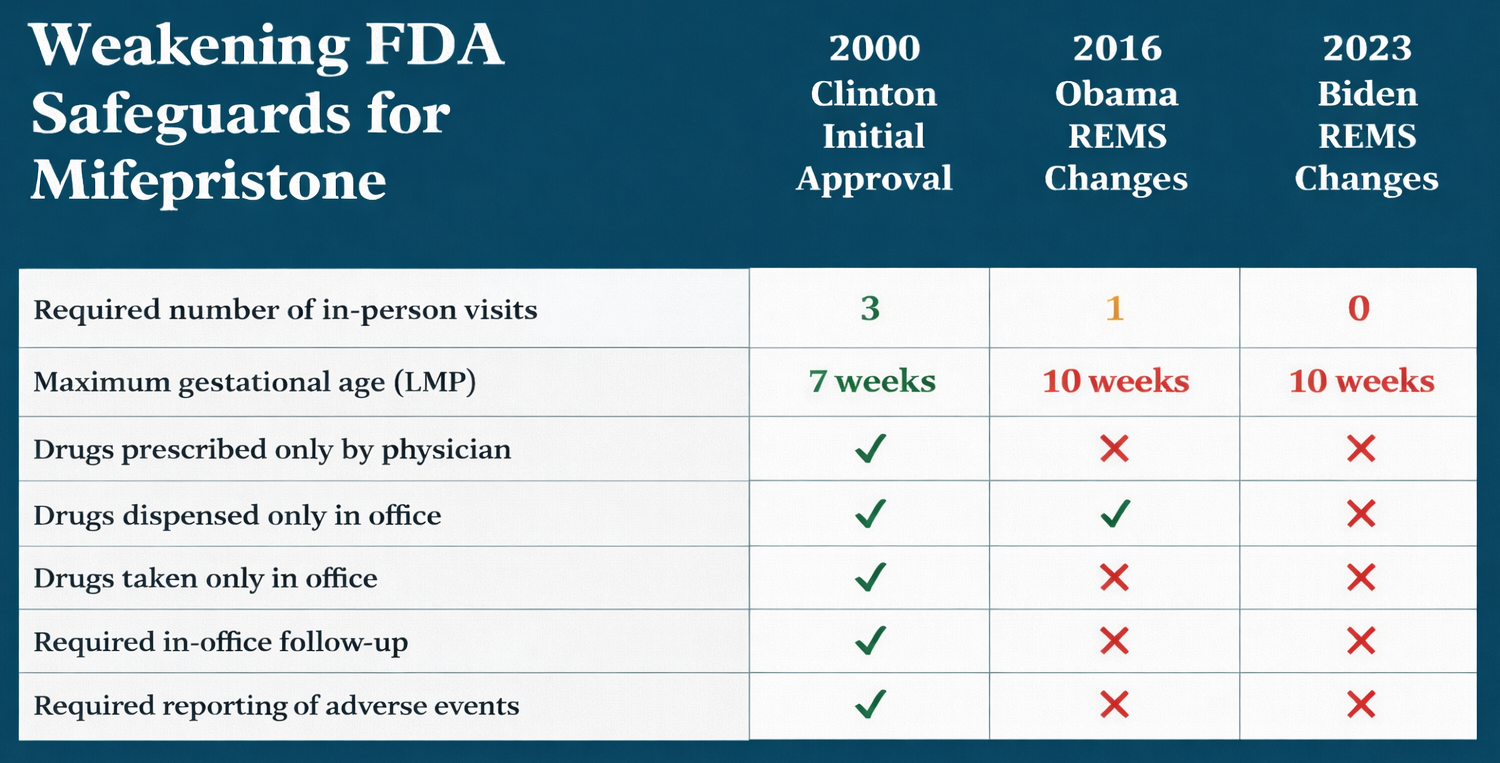
FACTS – Abortion Pill Expansion

HB 195

Pharmacy Abortion Pill Distribution

HB 195 allows pharmacists to prescribe, administer, and dispense abortion pills like mifepristone and misoprostol by forming Collaborative Practice Agreements (CPAs).

–  Collaborative Practice Agreements (CPAs) allow abortion doctors to delegate their abortion pill prescribing and dispensing authority to their pharmacist CPA partner(s).

–  A CPA is doctor/pharmacist joint practice in which the doctor writes the rules and protocols for the CPA and the pharmacist treats patients, prescribes, administers, and dispenses drugs – abortion pills – within the boundaries set by the doctor – the abortionist.

–  Collaborative Practice Agreements are defined by the Agreement itself.  CPAs are:

–  Self defining.

–  Self regulating.

–  Self limiting.

–  Independent of Medical or Pharmacy Board regulation.

–   Since the CPA defines what the abortion doctor will delegate, and what the pharmacist can prescribe, the final limiting factor is the pharmacist’s education, training, and experience.

–  The CPA protocols provide the pharmacist’s abortion pill education and training.  The pharmacist’s own drug preparation and dispensing education and training, and experience is more than sufficient for handling and dispensing abortion pills. 

–  HB 195 is written so that it can be broadly interpreted to create independent misoprostol-only abortion prescribing authority, or it can be narrowly interpreted requiring  CPAs to create the framework for abortion doctors to delegate their abortion pill prescribing, administering, OR dispensing authority to their pharmacist CPA partner(s).

Regardless of how HB 195 is interpreted, there is a clear pathway to pharmacists  prescribing, administering, OR dispensing abortion pills across Alaska with little regard for women’s health and safety, and no regard for the pre-born images of God that will be murdered by those pills.

HB 195 allows pharmacists to prescribe, administer, and dispense abortion pills like mifepristone and misoprostol because the bill allows abortionists and pharmacist to form self defining, regulating, and limiting collaborative practices (CPAs) that allow abortionists to delegate their abortion pill prescribing and dispensing authority to their pharmacist partner(s).

–  HB 195 is written so that it can be broadly interpreted to create independent misoprostol-only abortion prescribing authority, or it can be narrowly interpreted to create Collaborative [Abortion] Practice Agreements (CPAs) that are self defining, self regulating, and self limiting abortion/pharmacy-practices.  Those CPAs create the framework for abortionists to delegate their abortion pill prescribing, administering, OR dispensing authority to the pharmacist(s) they partner with.

–  Because Alaska’s abortion statutes, AS 18.16, do not recognize whether an “abortion is performed” when abortion pills are prescribed, administered, or dispensed, there is further confusion about which action constitutes the abortion – or if all three are considered the single act of ‘an abortion.’

–  Additionally, the nature of Collaborative [Abortion] Practice Agreements adds further confusion about who legally performs the abortion, since the pharmacist cannot legally ‘perform’ an abortion, but the abortionist CAN delegate his abortion pill prescribing, administering, OR dispensing authority to the pharmacist(s) he partners with.

–   Since the Collaborative [Abortion] Practice Agreements define what the abortionist can delegate, and what the pharmacist can prescribe, the only limiting factor becomes the pharmacists education, training and experience.

–  The Collaborative [Abortion] Practice Agreement protocols provide the pharmacist’s abortion pill education and training, and his own drug preparation and dispensing experience is more than sufficient to dispense abortion pills. 

Regardless of how HB 195 is interpreted, there is a clear pathway to pharmacist prescribed, administered, OR dispensed abortion pill proliferation across Alaska with little regard for women’s health and safety, and no regard for the pre-born images of God that will be murdered by them.

Below are a few simple, and practical ways of describing how HB 195 turns participating pharmacists into abortionists.

–  HB 195 allows pharmacists to prescribe, administer, and dispense abortion pills like mifepristone and misoprostol because the bill allows abortionists and pharmacist to form self defining, regulating, and limiting collaborative practices (CPAs) that allow abortionists to delegate their abortion pill prescribing and dispensing authority to their pharmacist partner(s).

–  HB 195’s Collaborative Practice Agreements (CPAs) allow pharmacists to prescribe, administer, and dispense abortion pills like mifepristone and misoprostol.

–  Abortionists and pharmacists can form private, self-regulating abortion/pharmacy businesses under HB 195’s Collaborative Practice Agreements (CPAs).  The CPAs allow pharmacists to prescribe, administer, and dispense abortion pills like mifepristone and misoprostol.

–  HB 195’s Collaborative Practice Agreements are self defining, self regulating, and self limiting medical practices that create the framework for abortionists to delegate their abortion pill prescribing, administering, and dispensing authority to the pharmacist(s) they partner with.

–  HB 195 is written so that it can be broadly interpreted to create independent misoprostol-only abortion prescribing authority, or it can be interpreted narrowly to create Collaborative [Abortion] Practice Agreements that are self defining, self regulating, and self limiting abortion/pharmacy-practices that create the framework for abortionists to delegate their abortion pill prescribing, administering, OR dispensing authority to the pharmacist(s) they partner with.

–  Because Alaska’s abortion statutes, AS 18.16, do not recognize whether an “abortion is performed” when abortion pills are prescribed, administered, or dispensed, there is further confusion about which action constitutes the abortion – of if all three are considered the single act of ‘an abortion.’

–  Additionally, the nature of Collaborative [Abortion] Practice Agreements adds further confusion as to whether the abortion is performed by the abortionist or the pharmacist since the pharmacist cannot legally ‘perform’ an abortion, but the abortionist’s prescription, administering, and dispensing authority can be delegated to the pharmacist within the Collaborative [Abortion] Practice Agreements that are self defining, self regulating, and self limiting under HB 195.

HB 195 allows abortion pills to be prescribed and dispensed by pharmacists when they form a collaborative practice with an abortionist that becomes a private, self-regulating abortion/pharmacy business.

HB 195 allows

Abortionists and pharmacists can form private, self-regulating abortion/pharmacy businesses under HB 195’s Collaborative Practice Agreement (CPA) provisions that allow pharmacists to prescribe, administer, and dispense abortion pills like mifepristone and misoprostol.

HB 195’s Collaborative Practice Agreements (CPAs) allow pharmacists to prescribe, administer, and dispense abortion pills like mifepristone and misoprostol.

HB 195’s CPAs are self defining, self regulating, and self limiting medical practices that create the framework for abortionists to delegate their abortion pill prescribing, administering, and dispensing authority to the pharmacist(s) they partner with.

HB 195’s Collaborative Practice Agreements are self defining, self regulating, and self limiting medical practices that create the framework for abortionists to delegate their abortion pill prescribing, administering, and dispensing authority to the pharmacist(s) they partner with.

HB 195 is written so that it can be broadly interpreted to create independent misoprostol-only abortion prescribing authority, or it can be interpreted narrowly to create Collaborative [Abortion] Practice Agreements that are self defining, self regulating, and self limiting abortion/pharmacy-practices that create the framework for abortionists to delegate their abortion pill prescribing, administering, OR dispensing authority to the pharmacist(s) they partner with.

Because Alaska’s abortion statutes, AS 18.16, do not recognize whether an “abortion is performed” when abortion pills are prescribed, administered, or dispensed, there is further confusion about which action constitutes the abortion – of if all three are considered the single act of ‘an abortion.’

Additionally, the delegatory nature of Collaborative [Abortion] Practice Agreements adds further confusion as to whether the abortion is performed by the abortionist or the pharmacist since in some circumstances, the pharmacist cannot legally ‘perform’ an abortion, but the abortionist’s abortion pill prescription, administering, and dispensing authority can be delegated to the pharmacist within the Collaborative [Abortion] Practice Agreements that is self defining, self regulating, and self limiting under HB 195.

HB 195 extends abortion pill distribution by making four primary changes to Alaska pharmacy law:

1)  Authorizing pharmacists to prescribe and administer drugs and devices (Sec. 34, AS 08.80.337).

2)  Redefining pharmacists’ practice through Collaborative Practice Agreements (CPAs) (Sec. 33, AS 08.80.337(a)).   

3)  Removing the State’s authority to regulate Collaborative Practice Agreements  (Sec. 4, AS 08.02.150).

4)  Creating a loophole for misoprostol-only abortions (Sec. 35 (2)(C), AS 08.80.337(d)).

The CPA establishes an abortion/pharmacy-practice that allows the abortionist to delegate his abortion pill prescribing, administering, and dispensing authority to the pharmacist.

The CPA expands the pharmacist’s scope of practice to include prescribing, administering, and dispensing abortion pills to pregnant women who are deemed to be less than 11 weeks past her last menstrual period (LMP).

The CPA establishes the protocols approved by the abortionist that outlines the tests the pharmacist will administer or evaluate before prescribing, administering, or dispensing abortion pills.  

The CPA limits the pharmacist’s scope of practice to his interpretation of his own ‘education, training, and experience.’ In other words, the abortionist ensures the pharmacist is educated and trained to identify key pregnancy factors that contradict an abortion pill prescription, like being too more than 11 weeks LMP, or having an ectopic pregnancy. 

The pharmacist is highly educated, trained, and experienced at administering and dispensing pills.

If the abortionist and pharmacist believe that Sec. 35 of the bill restricts mifepristone abortions from use in the CPA, then Sec. 35 ALSO contains a loophole for misoprostol-only abortions.

–  Section 35 may prohibit FDA REMS classified and regulated drugs from being prescribed or administered by a pharmacist (dispensing is not mentioned):

–  “(d)… patient care services…(2) does not include the prescription or administration of…

–  (B) a drug that may only be prescribed or administered after completing a certified education program required by the

–  (i) manufacturer; or

–  (ii) the United States Food and Drug Administration, including by a risk evaluation and mitigation strategy [REMS]”

What all of this means is that if the abortion pill makers or the FDA require a certified education program, then mifepristone abortions would be prohibited from prescription and administration within the CPA.  

However, Sec. 35 ALLOWS pharmacists to dispense mifepristone abortions within the CPA – and they can likely dispense abortion pills independently as well.

Worse yet, Sec. 35 creates a LARGE LOOPHOLE for misoprostol-only abortions:

–  “(d)… patient care services…(2) does not include the prescription or administration of…

–  “(C) a drug that is not generally available at pharmacies and may only be dispensed at a pharmacy that is (i) authorized by the manufacturer to dispense the drug; or

–  (ii) meets a requirement to dispense the drug under federal law.”

This section of the bill says that since misoprostol is already generally available at pharmacies, then no restrictions are placed on pharmacies continuing to carry and dispense the drug.  

Section 35 also authorizes pharmacists to prescribe and administer misoprostol-only abortions (possibly without a CPA) because is generally available at pharmacies.

**UNDER CONSTRUCTION**

Abortion activists and Big Pharma lobbyists claim that HB 195 has nothing to do with abortion pills, and does not regulate abortion in any way.

But because the bill is silent on any abortion drug specifically, or an abortion drug’s purpose – killing a baby – the bill may restrict Mifepristone prescriptions (not dispensing) while opening Misoprostol-Only Abortion prescriptions for statewide prescriptions and distributions.

Mifepristone is the most widely known abortion drug in America because it is one of the only drugs to be FDA approved as an abortion drug, and because its approval and use is highly controversial.

The controversy comes from the number of women injured and killed by the drug as opposed to the number of babies killed with the drug.

Mifepristone is one of the few Risk Evaluation Mitigation System (REMS) regulated drugs because has always been known to cause serious and even life-threatening complications.

The FDA requires Mifepristone to be prescribed with Misoprostol – it is not legally prescribed as a standalone abortion drug.

Misoprostol is the most widely used abortion drug – in part because it is step two in the Mifepristone regimen, but also because it is widely used in Misoprostol-Only Abortions.

When Mifepristone is not available, then Misopristol is prescribed as a stand-alone drug.

Misoprostol is a simple, non-scheduled, prescription drug that is used off-label for a wide variety of purposes.

Nearly every pharmacy carries Misoprostol and can quickly fill a Misoprostol-Only Abortion prescription.

Misoprostol is not preferred because it is not designed to kill a baby, but rather to cause contractions – which kill a baby in the process of ‘delivering’ him – alive or dead – up to 10 weeks.

Please take a moment and SIGN the Petition and then CALL Governor Dunleavy.

In just 3 minutes you can call his office leave a brief message urging him to VETO HB 195, and move on with your day.

Call the number for your part of the state or click or dial (907) 465-3500 to call the Governor in Juneau (where he is currently working).

Anchorage: click or dial (907) 269-7450.

Fairbanks: click or dial (907) 451-2920.

Kenai Peninsula: click or dial (907) 420-3999.

Mat-Su: click or dial (907) 761-5691.

Your call is simple: please VETO HB 195 because it allows pharmacists to prescribe, administer, or dispense abortion pills.

Collaborative Practice Agreements

The Collaborative Practice Agreement (CPA) is the hinge on which the pharmacist/abortion-pill door swings.

A CPA is a private medical partnership between a pharmacist and another licensed prescriber, like your family practice doctor, the nurse practitioner at the local urgent care, or a physician assistant working in the emergency room.

Current CPAs are relatively limited. HB 195 changes that.

HB 195 Collaborative Practice Agreements can redefine the pharmacist’s scope of practice, meaning the private contract between abortionist and pharmacist can expand the pharmacist’s practice to include prescription, administration, and dispensing of abortion pills. 

At the same time, HB 195 removes the State’s authority to approve, define, or “otherwise regulate Collaborative Practice Agreements.”

ABORTION // PHARMACIST CPA

ABORTION // PHARMACIST CPA

  1.  REDEFINES the pharmacist’s scope of practice to include prescribing, administering, or dispensing abortion pills. 

  2.  REMOVES the State’s authority to regulate the CPA.

That combination is what makes abortion-pill expansion possible.

Supporters respond by saying “the bill doesn’t mention abortion.”

In reality, the bill is silent on nearly every category of drug except certain high risk or controlled substances. The bill broadly expands pharmacist prescribing and administering authority rather than limiting the expansion to a narrow category of controlled substances.

Under HB 195, many treatments that previously required a visit to a family doctor, urgent care clinic, or emergency room can be prescribed, administered, and dispensed directly through a pharmacy — in some cases without a CPA at all.

That’s likely a good thing.  But the veneer of quicker, cheaper prescriptions at the corner drug store is hiding the rot of abortion activism underneath.

HB 195‘s abortion pill expansion rot allows private, unregulated CPAs to redefine the pharmacist’s role in the abortion pill business.

Imagine that an abortionist in Anchorage wants to expand her business into rural Alaska.  She could partner with a pharmacist in Bethel, Barrow, or anywhere in between – and establish the necessary protocols, delegate her prescribing and dispensing functions under the CPA to her pharmacist partner(s), and expand her abortion pill business into areas that previously required long drives or multiple plane rides to Anchorage or Fairbanks.

HB 195 goes further than just opening the door to pharmacy-based abortion pill prescriptions, HB 195 prohibits the the State Medical Board or Board of Pharmacy from approving, denying, amending, limiting, or “otherwise regulating collaborative practice agreements.” The agreement itself defines what work is done, by whom, and under what protocols.

The bill’s primary limiting factor is the pharmacist’s “education, training, and experience.” But HB 195 does not define:

• what training is sufficient,
• who determines adequacy,
• what standards apply, or
• who enforces those standards.

In practice, that leaves the pharmacist and abortionist largely in control of how far the pharmacist’s scope of practice expands into the abortion business under the CPA.

HB 195

GOVERNOR'S VETO

Alaska’s Constitution provides very clear processes for what happens to a bill that has passed the Legislature.

The Governor must sign, veto, or allow a bill to become law within a specific amount of time:

  • 15 days, not counting Sundays, if the Legislature is in Session.
  • 20 days, not counting Sundays, if the Legislature is not in session.

The Legislature is currently is a Special Session, so the 15 day rule applies.

The Legislature has not yet sent HB 195 to the Governor.

Today is . Fifteen days from now, not counting Sundays, is .

This notice is effective as of , and the response deadline is .

MAY 20, 2026

HB 195 Passed From the Senate

Senate Republicans helped BIG ABORTION and Big Pharma PASS Abortion Bill HB 195 from the Senate on May 20th.

After a contentious day in which bill sponsor (the Senate version) Cathy Giessel tried to sneak the bill through twice, she finally got her way.

The Senate Democrat Majority ‘called time-out’, huddled, and even went to their caucus chambers twice before Giessel got her vote, winning passage of HB 195 from the Senate with 14 other Senators voting with her, and just 5 Republicans voting against.

In both key votes of the day, members of the Republican Caucus crossed the aisle to give the democrats the votes the needed to advance and pass the bill.

Key among the Republicans snatching defeat from the jaws of victory were:

  • Senate Minority Leader Mike Cronk (R) from Tok – voted yes in the most critical vote – a motion to advance or kill the bill, requiring 3/4 vote to advance HB 195.
  • Senator James Kaufman (R) from Anchorage – Kaufman voted with the Democrats twice to pass the bill.

Neither Cronk nor Kaufman are up for re-election in 2026 – and we’ll look for the 30 pieces of silver the Democrats pay next year when they organize the 35th Legislature.

A green YEA was a vote to advance from 2nd to third reading (below), and for Final Passage (above) from the Senate.

MAY 20, 2026

The Vote That Matters Most

REPUBLICANS VOTING WITH BIG ABORTION

SENATE

Tok – Mike Cronk
Anchorage – James Kaufman

Pro-Abortion Democrats had 14 votes – they only needed 11 for Final Passage.

But to GET to Final Passage, they needed 15 votes.

When Republican Minority Leader Cronk and Republican Minority Member Kaufman crossed the aisle, giving them votes 15 and 16, they delivered HB 195 to the Abortion Lobby and Big Pharma on a silver platter.


Other Republicans Voting with the Abortion Lobby

Kenai/Soldotna – Jesse Bjorkman
Eagle River – Kelly Merrick
Sitka – Bert Stedman
Kodiak – Gary Stevens
Anchorage – Cathy Giessel (Senate Sponsor)

Abortionists and pharmacists have an OPEN DOOR to Misoprostol-Only Abortions in nearly every pharmacy in Alaska.

MAY 15, 2026

HB 195 Passed From House To Senate

House Republicans helped BIG ABORTION and Big Pharma PASS Abortion Bill HB 195 from the House to the Senate on May 15th.

A green YEA was a vote for Final Passage from the House to the Senate.

REPUBLICANS VOTING WITH BIG ABORTION

Wasilla – Steve St. Clair
Wasilla – Elexie Moore
Wasilla – Jubilee Underwood
Eagle River – Dan Saddler
Soldotna – Justin Ruffridge
Soldotna – Bill Elam
North Pole – Mike Prax
Anchorage – David Nelson
Anchorage – Chuck Kopp
Anchorage – Coulombe
Ketchikan – Bynum

Each of these Republicans knew exactly what they were voting for – an abortion bill.

Before the final vote, several made speeches about the bill and the abortion pill expansion in the bill.

Eagle River Representative Jamie Allard torched many in the Republican caucus whose votes on the pro-life amendment she offered were inconsistent with their votes on Final Passage.

Many of these Republicans will post a victory lap like Elexie Moore did on May 11th about how this bill is a win for Alaskan healthcare, and that it contains “guardrails” against Mifepristone abortions.

But the bill does NOTHING to prevent pharmacists from prescribing, administering, or dispensing Misoprostol-Only Abortions.

If anything, as you can see HERE and that the de-regulation of pharmacy practices is  BROAD  and  SWEEPING.

Patient Care Services is redefined by newly expanded Collaborative Practice Agreements that expand the limits of a pharmacist’s ability to prescribe, administer, and dispense drugs like Mifepristone and Misoprostol.

Patient Care Services is expanded for pharmacists so that they can independently prescribe, administer, and dispense drugs.  As the courts continue to neuter the ‘physician only rule’ in AS 18.16 (abortion law), we should expect to see pharmacists added to the growing list of abortion pill prescribers.

The bill also removes the State’s authority to approve, define, or otherwise regulate collaborative practice agreements.

The practical outcome is that HB 195 authorizes pharmacists to partner with abortionists under a Collaborative Practice Agreement, and start prescribing, administering, and dispensing abortion pills.

While the Mifepristone Abortion prescription authority is debatable given the House Finance amendment below, the Misoprostol-Only Abortions is not.

The bill does not provide any protection against Misoprostol-Only Abortions in pharmacies – whether prescribed, administered, or dispensed by pharmacists.

MAY 15, 2026

Republicans Help Kill

Pro-Life Amendment

Before voting on the Final Passage from the House, Republicans helped BIG ABORTION and Big Pharma KILL Pro-Life Amendment #1 to HB 195 on May 15th.

In this case, a green YEA was a vote to KILL Amendment 1 to HB 195.

Amendment 1:

REPUBLICANS VOTING WITH BIG ABORTION

Eagle River – Dan Saddler
Soldotna – Justin Ruffridge
North Pole – Mike Prax
Anchorage – Coulombe
Ketchikan – Bynum


Other Republicans are highlighted because they spoke against the Amendment, or after voting against killing the Amendment, they voted FOR the Abortion Bill HB 195 to PASS the House.

Each of these Republicans knew exactly what they were voting for – an abortion bill.

Before the final vote, several made speeches about the bill and the abortion pill expansion in the bill.

Eagle River Representative Jamie Allard torched many in the Republican caucus whose votes on the pro-life amendment she offered were inconsistent with their votes on Final Passage.

Many of these Republicans will post a victory lap like Elexie Moore did on May 11th about how this bill is a win for Alaskan healthcare, and that it contains “guardrails” against Mifepristone abortions.

But the bill does NOTHING to prevent pharmacists from prescribing, administering, or dispensing Misoprostol-Only Abortions.

If anything, as you can see HERE and that the de-regulation of pharmacy practices is  BROAD  and  SWEEPING.

Patient Care Services is redefined by newly expanded Collaborative Practice Agreements that expand the limits of a pharmacist’s ability to prescribe, administer, and dispense drugs like Mifepristone and Misoprostol.

Patient Care Services is expanded for pharmacists so that they can independently prescribe, administer, and dispense drugs.  As the courts continue to neuter the ‘physician only rule’ in AS 18.16 (abortion law), we should expect to see pharmacists added to the growing list of abortion pill prescribers.

The bill also removes the State’s authority to approve, define, or otherwise regulate collaborative practice agreements.

The practical outcome is that HB 195 authorizes pharmacists to partner with abortionists under a Collaborative Practice Agreement, and start prescribing, administering, and dispensing abortion pills.

While the Mifepristone Abortion prescription authority is debatable given the House Finance amendment below, the Misoprostol-Only Abortions is not.

The bill does not provide any protection against Misoprostol-Only Abortions in pharmacies – whether prescribed, administered, or dispensed by pharmacists.

MAY 11, 2026

HOUSE FINANCE COMMITTEE

House Republicans on the Finance Committee helped BIG ABORTION and Big Pharma neuter amendments that would have prevented pharmacists from prescribing, administering, or dispensing progesterone receptor modulating drugs – Mifepristone – and any other abortion inducing drug.

Led by Representative Justin Ruffridge (R, Soldotna), the architect of HB 195 and Representative Genevieve Mina (D, Anchorage), the bill’s sponsor and champion, House Finance Committee Republicans joined the Democrats in killing the only amendment that would have prohibited pharmacist prescribed and dispensed abortion inducing drugs.

Representative Genevieve Mina

Planned Parenthood Endorsed

Anchorage Democrat

HB 195 Sponsor

Representative Justin Ruffridge

Soldotna Republican

HB 195 “Architect”

Voting AGAINST Pro-Life Amendment #5

Fairbanks Republican Will Stapp

Ketchikan Republican Jeremy Bynum

Wasilla Republican Elexie Moore

BACKGROUND

In 2025, Representative Genevieve Mina (D) partnered with Senate Majority Leader Senator Cathy Giessel (R), in a dangerous “pharmacy modernization” experiment (HB 195 & SB 147) that is so wildly beyond their abilities that it would expand Chemical Abortion (Mifepristone) access from Anchorage and Fairbanks Planned Parenthood sites to virtually every city, town, and village that has a hospital, clinic, or pharmacy.

These bills present at least two significant risks to babies and mothers at risk of committing, or being killed by Chemical Abortions:

1. The number of Chemical Abortions will increase exponentially virtually overnight. 

2.  The number of women seriously harmed by Chemical Abortions will increase dramatically.

What’s at stake with HB 195 & SB 147?

The RU 486 Chemical Abortion Cocktail of Mifepristone and Misoprostol killed 720 babies and sent 79 women to the hospital with serious or life-threatening complications in 2024.

Planned Parenthood operated three abortion sites in 2024.  They have since closed their Juneau office, leaving only Anchorage and Fairbanks as primary abortion hubs.

HB 195 & SB 147 could lead to an exponential increase in abortion pill distribution sites from just two in 2026 to hundreds, all across Alaska.

20 additional abortion pill sites, each distributing just one abortion pill kit per week lead to an additional 1,040 babies killed, and 114 women sent to the hospital – or worse.

How The Bills Expand Abortion Pill Access

HB 195 & SB 147 change a few critical parts of existing pharmacy law:

1.  HB 195 & SB 147 authorize abortionists and pharmacists to diagnose pregnancies and other health conditions and illnesses under Collaborative Practice Agreements (CPA).  

From the bill:

Sec. 6. AS 08.80.337(a) is amended to read: 

(a)  A pharmacist may, under a collaborative practice agreement with a written protocol approved by a practitioner who is not a pharmacist, provide patient care services. The collaborative practice agreement must define the nature and scope of patient care services the pharmacist may provide under the agreement.

Sec. 7. AS 08.80.337(b) is amended to read: 

(b)  A pharmacist may independently provide patient care services for 

(3)  a condition that

(C)   requires a new diagnosis only if

(i)  the pharmacist uses a test to guide the pharmacist’s diagnosis or clinical decision making;

2.  HB 195 & SB 147 redefine patient care services to include prescribing, administering, and dispensing drugs and devices, including abortion pills such as misoprostol.

From the bill:

Sec. 8. AS 08.80.337(d) is amended to read: 

(d) In this section, “patient care services“

(1)  means medical care services, including the prescription or administration of a drug or device to a patient, that are given in exchange for compensation and intended to achieve outcomes related to the cure or prevention of a disease, elimination or reduction of a patient’s symptoms, or arresting or slowing of a disease process;

Senate Republicans helped BIG ABORTION and Big Pharma PASS Abortion Bill HB 195 from the Senate on May 20th.
After a contentious day in which bill sponsor (the Senate version) Cathy Giessel tried to sneak the bill through twice, she finally got her way.

The Senate broke twice before Giessel got her vote, winning passage of HB 195 from the Senate with 14 other Senators voting with her, and 5 Republicans voting against.

In both key votes of the day, Republicans from the Republican Caucus crossed the aisle to give the democrats the votes the needed to advance and pass the bill.

Key among the Republicans snatching defeat from the jaws of victory were:
Senate Minority Leader Mike Cronk (R) from Tok – voted yes in the most critical vote – a motion to advance or kill the bill, requiring 3/4 vote to advance HB 195.

Senator James Kaufman (R) from Anchorage – Kaufman voted with the Democrats twice to pass the bill.

Neither Cronk nor Kaufman are up for re-election in 2026 – and we’ll look for the 30 pieces of silver the Democrats pay next year when they organize the 35th Legislature.

A green YEA was a vote to advance from 2nd to third reading (below), and for Final Passage (above) from the Senate.

(30) “practice of pharmacy” means the interpretation, evaluation, and dispensing of prescription drug orders in the patient’s best interest; participation in drug and device selection, drug administration, drug regimen reviews, and drug or drug-related research; provision of patient counseling and the provision of those acts or services necessary to provide pharmaceutical care; the independent prescribing, dispensing, and administration of drugs in accordance with AS 08.80.168; providing patient care services in accordance with AS 08.80.337; the responsibility for compounding and labeling of drugs and devices except labeling by a manufacturer, repackager, or distributor of nonprescription drugs and commercially packaged legend drugs and devices; proper and safe storage of drugs and devices; and maintenance of proper records for them;

3.  HB 195 & SB 147 eliminate much of the Department’s and Board’s approval and oversight of CPAs.

From the bill:

* Sec. 08.02.150.  Regulation of collaborative practice agreements.

(a)  The department or board may not

(1) require a pharmacist to pay a fee to enter into, or provide patient care services under, a collaborative practice agreement;

(2)  require department or board approval of a collaborative practice agreement;

(3) define the nature and scope of patient care services a pharmacist provides under a collaborative practice agreement; or

(4) otherwise regulate collaborative practice agreements.

You can learn more about “collaborative practice agreements” under AS 08.80.337(a)

4. The FDA Risk Evaluation and Mitigation Strategy (REMS) for mifepristone has already been relaxed to permit pharmacists’ prescribing and dispensing mifepristone and other progesterone receptor modulators without in person examinations.

That means a pharmacist can go into business with a medical practice that commits or wants to commit abortions – chemical abortions through a Collaborative Practice Agreement (CPA).

Through that CPA, the abortion business can easily and inexpensively expand its reach into another part of town – or the state. 

And because the pharmacist can prescribe and dispense Mifepristone from the pharmacy (or clinic), the cost of expanding the abortion business is minimal.

The only thing left to do is hang advertisements for Mifepristone next to the birth control and early pregnancy test products in the pharmacy or clinic.

And since the demand for Chemical Abortions – Mifepristone – has doubled in the past five years, Alaska’s pharmacies are perfectly positioned to fill that demand.

Chemical Abortions DOUBLED in 5 years

In 2024, 720 babies were killed with Mifepristone/Misoprostol from just two abortion sites.

  • 413 more babies died horrific deaths in 2024 than in 2019.
  • 42 more mothers suffered from life-threatening complications in 2024 than in 2019.

Chemical Abortions doubled in five years because the Biden Administration made the pills more accessible, women are testing for pregnancies earlier, and the Chemical Abortion pills are perceived to be more ‘convenient than surgical abortions. 

Abortion Pill Expansion Champions

HB 195 & SB 147 Sponsors and Champions: Senator Cathy Giessel (R) and Representative Genevieve Mina.

Co-Sponsors include: 

Representative Gray (D)

Representative Prax (R)

Representative Story (D)

Representative Eischeid (D)

Senator Gray-Jackson (D)

Voting to ADVANCE the bill(s):

Representative Schwanke (R)

Representative Ruffridge (R)

Representative Saddler (R)

Representative Mears (D)

Representative Mina (D)

Representative Carrick (D)

Representative Hall (D)

Senator Giessel (R)

Senator Claman (D)

Senator Dunbar (D)

Senator Tobin (D)

Voting to ADVANCE without OPPOSITION:

Senator Yundt (R)

Senator Merrick (R)

Senator Bjorkman (R)

Representative Fields (D)

Voting to ADVANCE with AMENDMENT:

Representative Coulombe (R)

Representative Nelson, D. (R)

A Tsunami of Chemical Abortions

What started as a nightmarish 720 babies killed by Chemical Abortions from just 2 Abortion Sites in 2024 is about to become a tidal wave of abortions across Alaska.

Senate Bill 147 & House Bill 195 are companion bills marketed as pharmacy modernization bills that extend prescription authority to pharmacists that is currently limited to physicians, physician assistants, and some nurses. 

The bills also expand pharmacies’ dispensing authority to certain controlled substances.

The RU-486 Mifepristone/Misoprostol Chemical Abortion Cocktail can only be prescribed and dispensed in clinical environments in Alaska.

If HB 195 & SB 147 become law, a pregnant mother anywhere in Alaska can complete a telehealth interview with a Planned Parenthood nurse (a 2024 lawsuit expanded chemical abortion prescriptions to physician assistants and some nurses) and have a prescription for Mifepristone / Misoprostol – a Chemical Abortion – sent to the nearest dispensing clinic or pharmacy.

That means a pregnant mother in Kwigillingok, King Salmon, Tok, and even Adak can perform a Do-It-Yourself / Self-Managed Chemical Abortion without leaving her city, town, or village.

HB 195 / SB 147 could legalize more than 300 Chemical Abortion prescription and distribution sites.

Planned Parenthood’s two abortion sites employ only a handful of doctors and nurses that can prescribe and dispense Mifepristone.

Compare that to more than 1,340 Advanced Practice RNs in Alaska that could prescribe and dispense Mifepristone.

Putting this in plain, black and white numbers:  Three Planned Parenthood Abortion Sites prescribed and dispensed 720 Chemical Abortions in Alaska in 2024:

Anchorage Planned Parenthood = 540 Chemical Abortions (estimated).

Fairbanks Planned Parenthood = 180 Chemical Abortions (estimated).

What happens when an abortionist in New York sends a prescription to nearly any pharmacy in Alaska?

What happens when Native Health Consortium doctors and nurses prescribe Mifepristone from an Indian Health Services (IHS) telehealth centers and send the prescription to nearly any village clinic to be picked up.

Planned Parenthood’s two abortion sites employ only a handful of doctors and nurses that can prescribe and dispense Mifepristone.

Compare that to more than 1,340 Advanced Practice RNs in Alaska that could prescribe and dispense Mifepristone.

Worse, there are more than 4,100 pharmacists and pharmacy techs working in more than 300 hospitals, clinics, and pharmacies that could either prescribe or dispense Chemical Abortions according to HB 195 / SB 147.

Worse still, phone and internet abortion prescriptions are already available 24 hours / day. 

Instead of going to a Planned Parenthood abortion site that’s open 9-5, Monday-Friday, what happens when a pregnant mother can access a tele-health abortionist 24/7/365, and go to the corner pharmacy or village clinic and pick up the Abortion Pills?

Women outside of Anchorage or Fairbanks can go to a local clinic or pharmacy to pick up their abortion prescriptions – no more long drives to Anchorage or Fairbanks for long appointments “just” to pick up the pills.

Perhaps worst of all, Native women in rural Alaska can walk to the village clinic to pick up abortion prescriptions written by a Tribal Health or Native Hospital via tele-health nurse – no more long Medicaid funded trips to Anchorage, Fairbanks, or Seattle “just” to pick up two pills (Mifepristone & Misoprostol).

And all of this while the demand for access to Mifepristone across Alaska is increasing every year.

The possibilities are chilling:

  • 13 Rural Hospitals
  • 30(+) Federally Qualified Health Centers (FQHC)
    • 50 Community Health Aide Program (CHAPS) Clinics
    • 100(+) Sub-Regional Clinics
    • 50(+) Corner pharmacies and in nearly every store across the state:
    • 18 Carrs/Safeway
    • 11 Fred Meyer
    • 9 Walmart
    • 4 Costco
    • 4 Three Bears
    • 4 Walgreens

How many babies will die when Chemical Abortion pills can be picked up at hundreds of clinics and pharmacies across Alaska?

Every DIY Abortion Pill kills a baby.  But the carnage is not limited to the children that die slow, excruciating deaths.

1 in 10 mothers suffers serious to life-threatening complications.  In other words, more than 70* women went to the Hospital with serious and even life-threatening complications after killing their babies with Abortions Pills.

The Ethics and Public Policy Center (EPPC) conducted the largest known study on Mifepristone last year based on six years’ of insurance claims data that includes 865,727 Mifepristone abortions.  The EPPC claims data and adverse events applied to Alaska in 2024 would project roughly:

  • 34 Emergency room visits or 4.73% of Alaskan women that have Chemical Abortions
  • 24 Hemorrhage or 3.31%
  • 20 Surgical abortions to complete botched Chemical Abortions  or 2.84%
  • 10 Infections or 1.34%
  • 5 Hospitalizations or 0.66%

41 Other abortion-related complications or 5.68%

While Danco Laboratories markets Mifeprex (the market name) as “the safe and abortion pill,” Planned Parenthood tells the world that “it’s safer than Tylenol,” and the FDA approved it for use with almost no limitations, the EPPC study found that 10.93% women suffer sepsis, hemorrhaging, infection or other serious complications in the 45 days following a Chemical Abortion.

The EPPC Study makes it clear that in addition to claiming the life of a baby, Mifepristone – Abortion Pill – will send nearly 11% of women that take the deadly chemical cocktail to the hospital – or even the morgue.

Every Chemical Abortion kills at least one person – a baby. 

1 in 10 Chemical Abortions ends in a serious or life-threatening trip to the Emergency Room – in septic shock, bleeding, infected, or worse.

With the barriers to Mifepristone prescriptions virtually eliminated, the number of women accessing Chemical Abortions will skyrocket.

If the 50 retail pharmacies listed above dispensed just one Chemical Abortion per week, the carnage skyrockets 370% beyond an already unacceptable number of babies killed:

2,600 MORE babies would die horrible deaths.

284 more women would suffer serious to life-threatening complications within 45 days of taking the abortion pills.

  • 123 MORE Emergency room visits or 4.73%
  • 86 MORE Hemorrhage or 3.31%
  • 74 MORE Surgical abortions due to botched Chemical Abortions  or 2.84%
  • 35 MORE Infections or 1.34%
  • 17 MORE Hospitalization or 0.66%
  • 148 MORE abortion-related complications or 5.68%

There are also 193 hospitals, clinics and health centers that could prescribe and dispense Abortion Pills across the state.

The number of babies killed by Chemical Abortions alone could reach into the thousands – and the number of women suffering serious and life-threatening adverse events could reach the hundreds!

What happens when a pregnant mother takes the Mifepristone to kill her baby in a remote town or village? 

Will a boat, ferry, or plane get her to a distant hospital in time to save her life?

What happens when there is no Emergency Room?

What happens when there is no hospital?

What happens when there is no ambulance?

What happens when there is no help?

If a woman takes an Abortion Pill where boat, ferry, or airplane ride separates her from life-saving treatment, then what happens is she never makes it to the E.R. or hospital?

The EPPC Study does not count deaths – and Big Abortion certainly won’t report abortion related deaths.  Without access to hospitals, emergency rooms, blood transfusions, and D&C procedures, how many of those women won’t survive?

I know what you’re thinking: “why haven’t I heard of this before?”  

You haven’t heard of this before simply because women in rural Alaska don’t (legally) take Abortion Pills in their towns and villages.  That happens in Anchorage and Fairbanks right now.

But if HB 195 / SB 147 become law and they can pick up the Abortion Pills at a rural pharmacy or village clinic, how many more remote abortions will happen, how many more babies will die, and how many more women will suffer serious complications and possibly die because help is too far away?

But remember, this isn’t about “keeping abortion safe,” but about stopping an exponential increase of babies being killed – and the likelihood that many women will die as well.

This is about preventing a radical expansion of Chemical Abortions across Alaska.

This is about protecting desperate mothers and their babies from the predatory lies of Big Abortion and the politicians they employ in our Legislature.

This is about protecting thousands more babies from being murdered by Abortion Pills every year.

Can it get worse?

Big Abortion wants this bill to pass.

Big Pharma really wants this bill to pass.

They have the votes in the House to pass HB 195 / SB 147.

They have the votes in the Senate to pass HB 195 / SB 147.

Without you and thousands like you, HB 195 & SB 147 will become law in 2026.

Pro – Abortion Democrats control the Senate with 6 Planned Parenthood abortion activists, 2 more pro-abortion democrats, at least 6 Republicans supporting the bills – and a binding caucus that commits majority members’ votes to bills they bring to the Senate Floor.

Planned Parenthood abortion activists control 17 seats in the House plus independents and shape shifting Republicans like Stutes – they already have enough to pass the bill without the three Republican votes (Ruffridge, Prax, and Schwanke) already on their side.

Without massive action, HB 195 & SB 147 will sail through the House and Senate.

Without massive action, HB 195 & SB 147 will sail through the House and Senate.

We can’t do any of this without you.

We’re filling politicians’ inboxes with emails and petitions already – but we need more.  A lot more.

We’ve already sent more than 5,000 pressure mailers with phone call and petition QR codes into Anchorage and Eagle River – and we’re preparing more for every Republican that’s on the fence.

But we can’t rely on mail and phone calls alone – online education, outreach, and petition recruiting are key components of encouraging Senator Giessel and her colleagues to abandon these wildly dangerous bills.

Here’s what your gift can do right now:

$25 Delivers petitions and pressure mailers to key voters and lawmakers. 

$50 Recruits and deliver more petition signatures.

$100 Funds targeted outreach in key Republican districts.

$250 Powers larger waves of mail, digital pressure, and petition deliveries.

$500 Funds on-the-ground outreach and rapid-response mobilization.

$1,000 Expands a full legislative pressure campaign in Juneau.

Please contribute $25, $50, $125, $250, $500, $1,000 or any amount you can afford to help protect pre-born Alaskans and end abortion in Alaska.

We must fully fund this mobilization before the next committee vote – or BIG Pharma and BIG Abortion will lock in the votes they need.

If we fail, Chemical Abortions will spread across Alaska.

If we act now, we can STOP it.

We can’t do any of this without you.

We’re filling politicians’ inboxes with emails and petitions already – but we need more.  A lot more.

We’ve already sent more than 5,000 pressure pieces with phone call and petition QR codes into Anchorage and Eagle River – and we’re preparing more for every Republican that’s supporting the bill(s).

We can’t rely on mail and phone calls alone – online education, outreach, and petition recruiting are key components of encouraging Senator Giessel and her colleagues to abandon these wildly dangerous bills.

Here’s what your gift can do right now:

  $25 Delivers petitions and pressure mailers. 

  $50 Recruits more petition signers.

  $100 Funds outreach in key Republican districts.

  $250 Widens mail, digital pressure, and petition deliveries.

  $500 Funds rapid-response mobilization.

  $1,000 Expands the Juneau pressure campaign.

Please contribute $25, $50, $125, $250, $500, $1,000 or any amount you can afford to help protect pre-born Alaskans and end abortion in Alaska.

Please contribute $25, $50, $125, $250, $500, $1,000 or any amount you can afford to help protect pre-born Alaskans and end abortion in Alaska.

We must fully fund this mobilization before the next committee vote – or BIG Pharma and BIG Abortion will lock in the votes they need.

If we fail, Chemical Abortions will spread across Alaska.

If we act now, we can STOP it.

QUESTIONS?

📞 CALL me at (907) 753-6397

📧 EMAIL  me at PATMARTIN@ALASKARIGHTTOLIFE.ORG

Copyright © 2025 · Alaska Right To Life
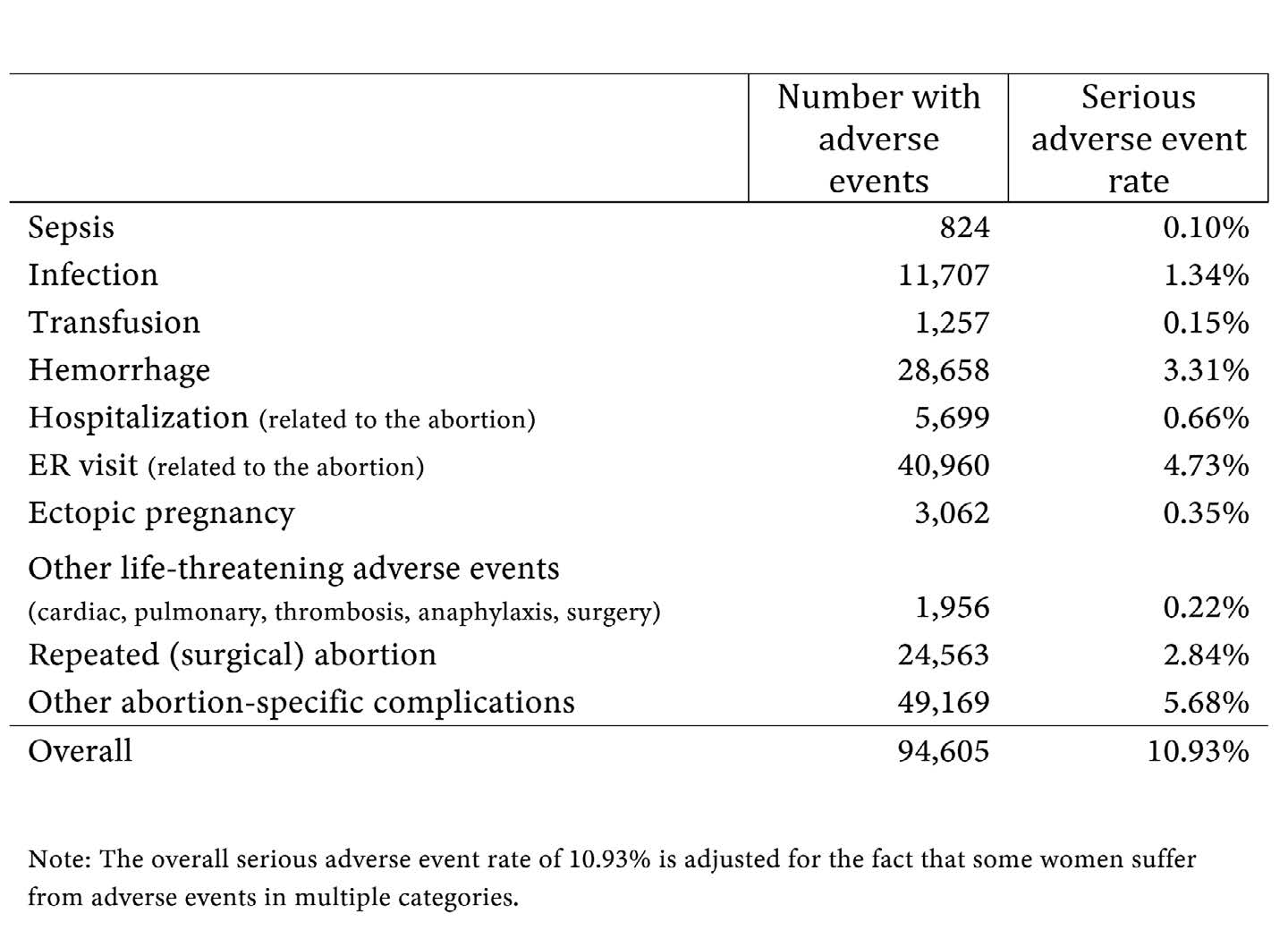
Mike Prax & Abortion Pills

Tell Mike Prax

NO

Abortion Pill

Expansion

North Pole (House District 33) Republican Mike Prax joined pro-abortion Democrats and rogue Republican Cathy Giessel in sponsoring Chemical Abortion EXPANSION HB 195.

Written as a ‘pharmacy modernization’ bill, the prescription, administration, and dispensing changes are so broad that virtually every pharmacy in Alaska could become an Abortion Pill dispensary.

HOW HB 195 EXPANDS ABORTION PILL ACCESS

1.  HB 195 allows abortionists and pharmacists to EXPAND ABORTION PILL DISTRIBUTION under Collaborative Practice Agreements (CPA).  

2.  HB 195 allows pharmacists to prescribe and administer ABORTION PILLS by redefining patient care services.

3.  HB 195 eliminates much of the Department’s and Board’s approval and oversight of CPAs.

4. Pharmacists can already prescribe and dispense mifepristone under the current FDA Risk Evaluation and Mitigation Strategy (REMS) for mifepristone.

HB 195 Bill Details

HB 195 changes a few critical parts of existing pharmacy law:

1.  HB 195 authorizes abortionists and pharmacists to diagnose pregnancies and other health conditions and illnesses under Collaborative Practice Agreements (CPA).  

From the bill:

Sec. 6. AS 08.80.337(a) is amended to read: 

(a)  A pharmacist may, under a collaborative practice agreement with a written protocol approved by a practitioner who is not a pharmacist, provide patient care services. The collaborative practice agreement must define the nature and scope of patient care services the pharmacist may provide under the agreement.

Sec. 7. AS 08.80.337(b) is amended to read: 

(b)  A pharmacist may independently provide patient care services for 

(3)  a condition that

(C)   requires a new diagnosis only if

(i)  the pharmacist uses a test to guide the pharmacist’s diagnosis or clinical decision making;

2.  HB 195 redefines patient care services to include prescribing, administering, and dispensing drugs and devices, including abortion pills such as mifepristone.

From the bill:

Sec. 8. AS 08.80.337(d) is amended to read: 

(d) In this section, “patient care services“

(1)  means medical care services, including the prescription or administration of a drug or device to a patient, that are given in exchange for compensation and intended to achieve outcomes related to the cure or prevention of a disease, elimination or reduction of a patient’s symptoms, or arresting or slowing of a disease process;

(30) “practice of pharmacy” means the interpretation, evaluation, and dispensing of prescription drug orders in the patient’s best interest; participation in drug and device selection, drug administration, drug regimen reviews, and drug or drug-related research; provision of patient counseling and the provision of those acts or services necessary to provide pharmaceutical care; the independent prescribing, dispensing, and administration of drugs in accordance with AS 08.80.168; providing patient care services in accordance with AS 08.80.337; the responsibility for compounding and labeling of drugs and devices except labeling by a manufacturer, repackager, or distributor of nonprescription drugs and commercially packaged legend drugs and devices; proper and safe storage of drugs and devices; and maintenance of proper records for them;

3.  HB 195 eliminates much of the Department’s and Board’s approval and oversight of CPAs.

From the bill:

* Sec. 08.02.150.  Regulation of collaborative practice agreements.

(a)  The department or board may not

(1) require a pharmacist to pay a fee to enter into, or provide patient care services under, a collaborative practice agreement;

(2)  require department or board approval of a collaborative practice agreement;

(3) define the nature and scope of patient care services a pharmacist provides under a collaborative practice agreement; or

(4) otherwise regulate collaborative practice agreements.

You can find more about “collaborative practice agreements” under AS 08.80.337(a)

4. The FDA Risk Evaluation and Mitigation Strategy (REMS) for mifepristone has already been relaxed to permit pharmacists’ prescribing and dispensing mifepristone and other progesterone receptor modulators without in person examinations.

That means a pharmacist can go into business with a medical practice that commits or wants to commit abortions – chemical abortions through a Collaborative Practice Agreement (CPA).

Through that CPA, the abortion business can easily and inexpensively expand its reach into another part of town – or the state. 

And because the pharmacist can prescribe and dispense Mifepristone from the pharmacy (or clinic), the cost of expanding the abortion business is minimal.

The only thing left to do is hang advertisements for Mifepristone next to the birth control and early pregnancy test products in the pharmacy or clinic.

And since the demand for Chemical Abortions – Mifepristone – has doubled in the past five years, Alaska’s pharmacies are perfectly positioned to fill that demand.

Chemical Abortions DOUBLED in 5 years

In 2024, 720 babies were killed with Mifepristone/Misoprostol from just two abortion sites.

  • 413 more babies died horrific deaths in 2024 than in 2019.
  • 42 more mothers suffered from life-threatening complications in 2024 than in 2019.

Chemical Abortions doubled in five years because the Biden Administration made the pills more accessible, women are testing for pregnancies earlier, and the Chemical Abortion pills are perceived to be more ‘convenient than surgical abortions. 

Abortion Pill Expansion Champions

HB 195 & SB 147 Sponsors and Champions: Senator Cathy Giessel (R) and Representative Genevieve Mina.

Co-Sponsors include: 

Representative Prax (R)

Representative Gray (D)

Representative Story (D)

Representative Eischeid (D)

Senator Gray-Jackson (D)

Voting to ADVANCE the bill(s):

Representative Schwanke (R)

Representative Ruffridge (R)

Representative Saddler (R)

Representative Mears (D)

Representative Mina (D)

Representative Carrick (D)

Representative Hall (D)

Senator Giessel (R)

Senator Claman (D)

Senator Dunbar (D)

Senator Tobin (D)

Voting to ADVANCE without OPPOSITION:

Senator Yundt (R)

Senator Merrick (R)

Senator Bjorkman (R)

Representative Fields (D)

Voting to ADVANCE with AMENDMENT:

Representative Coulombe (R)

Representative Nelson, D. (R)

Senate Majority Leader Senator Cathy Giessel (R), partnered with Representative Genevieve Mina (D), in a dangerous “pharmacy modernization” experiment (HB 195 & SB 147) that is so wildly beyond their abilities that it would expand Chemical Abortion (Mifepristone) access from Anchorage and Fairbanks Planned Parenthood sites to virtually every city, town, and village that has a hospital, clinic, or pharmacy.

These bills present at least two significant risks to babies and mothers at risk of committing, or being killed by Chemical Abortions:

1. The number of Chemical Abortions will increase exponentially virtually overnight. 

2.  The number of women seriously harmed by Chemical Abortions will increase dramatically.

A Tsunami of Chemical Abortions

What started as a nightmarish 720 babies killed by Chemical Abortions from just 2 Abortion Sites in 2024 is about to become a tidal wave of abortions across Alaska.

Senate Bill 147 & House Bill 195 are companion bills marketed as pharmacy modernization bills that extend prescription authority to pharmacists that is currently limited to physicians, physician assistants, and some nurses. 

The bills also expand pharmacies’ dispensing authority to certain controlled substances.

The RU-486 Mifepristone/Misoprostol Chemical Abortion Cocktail can only be prescribed and dispensed in clinical environments in Alaska.

If HB 195 & SB 147 become law, a pregnant mother anywhere in Alaska can complete a telehealth interview with a Planned Parenthood nurse (a 2024 lawsuit expanded chemical abortion prescriptions to physician assistants and some nurses) and have a prescription for Mifepristone / Misoprostol – a Chemical Abortion – sent to the nearest dispensing clinic or pharmacy.

That means a pregnant mother in Kwigillingok, King Salmon, Tok, and even Adak can perform a Do-It-Yourself / Self-Managed Chemical Abortion without leaving her city, town, or village.

HB 195 / SB 147 could legalize more than 300 Chemical Abortion prescription and distribution sites.

Planned Parenthood’s two abortion sites employ only a handful of doctors and nurses that can prescribe and dispense Mifepristone.

Compare that to more than 1,340 Advanced Practice RNs in Alaska that could prescribe and dispense Mifepristone.

Putting this in plain, black and white numbers:  Three Planned Parenthood Abortion Sites prescribed and dispensed 720 Chemical Abortions in Alaska in 2024:

Anchorage Planned Parenthood = 540 Chemical Abortions (estimated).

Fairbanks Planned Parenthood = 180 Chemical Abortions (estimated).

What happens when an abortionist in New York sends a prescription to nearly any pharmacy in Alaska?

What happens when Native Health Consortium doctors and nurses prescribe Mifepristone from an Indian Health Services (IHS) telehealth centers and send the prescription to nearly any village clinic to be picked up.

Planned Parenthood’s two abortion sites employ only a handful of doctors and nurses that can prescribe and dispense Mifepristone.

Compare that to more than 1,340 Advanced Practice RNs in Alaska that could prescribe and dispense Mifepristone.

Worse, there are more than 4,100 pharmacists and pharmacy techs working in more than 300 hospitals, clinics, and pharmacies that could either prescribe or dispense Chemical Abortions according to HB 195 / SB 147.

Worse still, phone and internet abortion prescriptions are already available 24 hours / day. 

Instead of going to a Planned Parenthood abortion site that’s open 9-5, Monday-Friday, what happens when a pregnant mother can access a tele-health abortionist 24/7/365, and go to the corner pharmacy or village clinic and pick up the Abortion Pills?

Women outside of Anchorage or Fairbanks can go to a local clinic or pharmacy to pick up their abortion prescriptions – no more long drives to Anchorage or Fairbanks for long appointments “just” to pick up the pills.

Perhaps worst of all, Native women in rural Alaska can walk to the village clinic to pick up abortion prescriptions written by a Tribal Health or Native Hospital via tele-health nurse – no more long Medicaid funded trips to Anchorage, Fairbanks, or Seattle “just” to pick up two pills (Mifepristone & Misoprostol).

And all of this while the demand for access to Mifepristone across Alaska is increasing every year.

The possibilities are chilling:

  • 13 Rural Hospitals
  • 30(+) Federally Qualified Health Centers (FQHC)
    • 50 Community Health Aide Program (CHAPS) Clinics
    • 100(+) Sub-Regional Clinics
    • 50(+) Corner pharmacies and in nearly every store across the state:
    • 18 Carrs/Safeway
    • 11 Fred Meyer
    • 9 Walmart
    • 4 Costco
    • 4 Three Bears
    • 4 Walgreens

How many babies will die when Chemical Abortion pills can be picked up at hundreds of clinics and pharmacies across Alaska?

Every DIY Abortion Pill kills a baby.  But the carnage is not limited to the children that die slow, excruciating deaths.

1 in 10 mothers suffers serious to life-threatening complications.  In other words, more than 70* women went to the Hospital with serious and even life-threatening complications after killing their babies with Abortions Pills.

The Ethics and Public Policy Center (EPPC) conducted the largest known study on Mifepristone last year based on six years’ of insurance claims data that includes 865,727 Mifepristone abortions.  In Alaska, this means:

  • 34 Emergency room visits or 4.73% of Alaskan women that have Chemical Abortions
  • 24 Hemorrhage or 3.31%
  • 20 Surgical abortions to complete botched Chemical Abortions  or 2.84%
  • 10 Infections or 1.34%
  • 5 Hospitalizations or 0.66%

41 Other abortion-related complications or 5.68%

While Danco Laboratories markets Mifeprex (the market name) as “the safe and abortion pill,” Planned Parenthood tells the world that “it’s safer than Tylenol,” and the FDA approved it for use with almost no limitations, the EPPC study found that 10.93% women suffer sepsis, hemorrhaging, infection or other serious complications in the 45 days following a Chemical Abortion.

The EPPC Study makes it clear that in addition to claiming the life of a baby, Mifepristone – Abortion Pill – will send nearly 11% of women that take the deadly chemical cocktail to the hospital – or even the morgue.

Every Chemical Abortion kills at least one person – a baby. 

1 in 10 Chemical Abortions ends in a serious or life-threatening trip to the Emergency Room – in septic shock, bleeding, infected, or worse.

With the barriers to Mifepristone prescriptions virtually eliminated, the number of women accessing Chemical Abortions will skyrocket.

If the 50 retail pharmacies listed above dispensed just one Chemical Abortion per week, the carnage skyrockets 370% beyond an already unacceptable number of babies killed:

2,600 MORE babies would die horrible deaths.

284 more women would suffer serious to life-threatening complications within 45 days of taking the abortion pills.

  • 123 MORE Emergency room visits or 4.73%
  • 86 MORE Hemorrhage or 3.31%
  • 74 MORE Surgical abortions due to botched Chemical Abortions  or 2.84%
  • 35 MORE Infections or 1.34%
  • 17 MORE Hospitalization or 0.66%
  • 148 MORE abortion-related complications or 5.68%

There are also 193 hospitals, clinics and health centers that could prescribe and dispense Abortion Pills across the state.

The number of babies killed by Chemical Abortions alone could reach into the thousands – and the number of women suffering serious and life-threatening adverse events could reach the hundreds!

What happens when a pregnant mother takes the Mifepristone to kill her baby in a remote town or village? 

Will a boat, ferry, or plane get her to a distant hospital in time to save her life?

What happens when there is no Emergency Room?

What happens when there is no hospital?

What happens when there is no ambulance?

What happens when there is no help?

If a woman takes an Abortion Pill where boat, ferry, or airplane ride separates her from life-saving treatment, then what happens is she never makes it to the E.R. or hospital?

The EPPC Study does not count deaths – and Big Abortion certainly won’t report abortion related deaths.  Without access to hospitals, emergency rooms, blood transfusions, and D&C procedures, how many of those women won’t survive?

I know what you’re thinking: “why haven’t I heard of this before?”  

You haven’t heard of this before simply because women in rural Alaska don’t (legally) take Abortion Pills in their towns and villages.  That happens in Anchorage and Fairbanks right now.

But if HB 195 / SB 147 become law and they can pick up the Abortion Pills at a rural pharmacy or village clinic, how many more remote abortions will happen, how many more babies will die, and how many more women will suffer serious complications and possibly die because help is too far away?

But remember, this isn’t about “keeping abortion safe,” but about stopping an exponential increase of babies being killed – and the likelihood that many women will die as well.

This is about preventing a radical expansion of Chemical Abortions across Alaska.

This is about protecting desperate mothers and their babies from the predatory lies of Big Abortion and the politicians they employ in our Legislature.

This is about protecting thousands more babies from being murdered by Abortion Pills every year.

Can it get worse?

Big Abortion wants this bill to pass.

Big Pharma really wants this bill to pass.

They have the votes in the House to pass HB 195 / SB 147.

They have the votes in the Senate to pass HB 195 / SB 147.

Without you and thousands like you, HB 195 & SB 147 will become law in 2026.

Pro – Abortion Democrats control the Senate with 6 Planned Parenthood abortion activists, 2 more pro-abortion democrats, at least 6 Republicans supporting the bills – and a binding caucus that commits majority members’ votes to bills they bring to the Senate Floor.

Planned Parenthood abortion activists control 17 seats in the House plus independents and shape shifting Republicans like Stutes – they already have enough to pass the bill without the three Republican votes (Ruffridge, Prax, and Schwanke) already on their side.

Without massive action, HB 195 & SB 147 will sail through the House and Senate.

Without massive action, HB 195 & SB 147 will sail through the House and Senate.

Here’s the plan:

  1. Overwhelming Opposition.  Senator Giessel and crew will either withdraw the bills or regret every vote on them in 2026.
    1. Stacks of petition boxes at the Capital steps and on every politicians’ desk.
    2. Thousands of electronic petitions to every politician in Juneau.
    3. Hundreds of thousands of emails flooding politicians’ inboxes.
    4. Thousands of phone calls, bringing the Legislature to a grinding halt.
  2. Statewide Campaign.  Alaska Right to Life members have already sent in hundreds of petitions – and more come in every day.
    1. Printing flyers.
    2. Recruiting petition collectors.
    3. Developing the normal tools  for a statewide campaign to defeat these bills.
  3. Local Action. To protect babies and their mothers from this deadly abortion expansion, we need to defeat these bills in their own districts– and hold their formerly pro-life representatives and senators accountable for advancing abortion expanding bills.
    1. Church / Pastor Education
    2. Town Hall engagement
    3. Literature Drops
    4. Petition Gathering at Local Events
    5. Candidate Recruitment

We can’t do any of this without you.

We’re filling politicians’ inboxes with emails and petitions already – but we need more.  A lot more.

We’ve already sent more than 5,000 pressure mailers with phone call and petition QR codes into Anchorage and Eagle River – and we’re preparing more for every Republican that’s on the fence.

But we can’t rely on mail and phone calls alone – online education, outreach, and petition recruiting are key components of encouraging Senator Giessel and her colleagues to abandon these wildly dangerous bills.

Here’s what your gift can do right now:

$25 Delivers petitions and pressure mailers to key voters and lawmakers. 

$50 Recruits and deliver more petition signatures.

$100 Funds targeted outreach in key Republican districts.

$250 Powers larger waves of mail, digital pressure, and petition deliveries.

$500 Funds on-the-ground outreach and rapid-response mobilization.

$1,000 Expands a full legislative pressure campaign in Juneau.

Please contribute $25, $50, $125, $250, $500, $1,000 or any amount you can afford to help protect pre-born Alaskans and end abortion in Alaska.

We must fully fund this mobilization before the next committee vote – or BIG Pharma and BIG Abortion will lock in the votes they need.

If we fail, Chemical Abortions will spread across Alaska.

If we act now, we can STOP it.

We can’t do any of this without you.

We’re filling politicians’ inboxes with emails and petitions already – but we need more.  A lot more.

We’ve already sent more than 5,000 pressure pieces with phone call and petition QR codes into Anchorage and Eagle River – and we’re preparing more for every Republican that’s supporting the bill(s).

We can’t rely on mail and phone calls alone – online education, outreach, and petition recruiting are key components of encouraging Senator Giessel and her colleagues to abandon these wildly dangerous bills.

Here’s what your gift can do right now:

  $25 Delivers petitions and pressure mailers. 

  $50 Recruits more petition signers.

  $100 Funds outreach in key Republican districts.

  $250 Widens mail, digital pressure, and petition deliveries.

  $500 Funds rapid-response mobilization.

  $1,000 Expands the Juneau pressure campaign.

Please contribute $25, $50, $125, $250, $500, $1,000 or any amount you can afford to help protect pre-born Alaskans and end abortion in Alaska.

Please contribute $25, $50, $125, $250, $500, $1,000 or any amount you can afford to help protect pre-born Alaskans and end abortion in Alaska.

We must fully fund this mobilization before the next committee vote – or BIG Pharma and BIG Abortion will lock in the votes they need.

If we fail, Chemical Abortions will spread across Alaska.

If we act now, we can STOP it.

QUESTIONS?

📞 CALL me at (907) 753-6397

📧 EMAIL  me at PATMARTIN@ALASKARIGHTTOLIFE.ORG

Copyright © 2025 · Alaska Right To Life

Judicial Review Becomes Judicial Rule When Legislators Refuse to Defend Life

This guest post is from David Eastman, answering the question: why do our elected representatives continue to hide behind judicial decrees instead of exercising their constitutional authority, in service to their oath to the Constitution – “…all persons have a natural right to life… to equality of rights… to equality under the law?”

From David Eastman:

In Alaska, the left controls state govt and most local governments,  with Republican support.

This is the part you don’t often hear. AK is a right of center state, controlled by Democrats, run by Republicans.

The idea of bucking that system is anathema to all elected Republican officials. It would be like going to the Soviet-backed puppet prime minister of Poland after WWII and saying “be more capitalist”. It’s a non-starter. They hold their position with the blessing of Moscow. If they cross Moscow they lose everything, so the idea of them doing so is anathema to their political future. And everything is about their political future.

So, everything you hear a Republican elected official say, or see a Republican elected official write, in this state, needs to first be filtered through this bedrock perspective that is universally held by those currently in office.

When push comes to shove, they don’t get their political power from Republicans. They get it (or perceive that they get it) by a political power structure over which the left has veto power.

A new court ruling that vetoes this or that part of the Alaska Constitution is just one method they have used to exercise that veto. There are others.

The left has even arrogated to itself  the power to veto any amendment to the Alaska Constitution that it doesn’t support.

This is the perceived reality in which legislators on both sides of the aisle operate. It has been this way for decades. Look at their actions (not simply their rhetoric) to confirm that this is true.

Also, look back over recent decades and try to find even one piece of conservative state policy that the legislature achieved that remains in operation today. Perhaps the closest I’ve been able to find is when the state was forced to step back from the multi-billion dollar boondoggle that was the defined benefit pension debacle, and only because they literally couldn’t afford it any longer (and even today we are still billions in the hole).

Here is the conclusion:

If you acquiesce to the left on being able to rewrite the AK Constitution whenever and for whatever reason they like, then you accept they have automatic veto authority over everything. They become Moscow and you as a state official are simply a puppet subject in every meaningful respect to the regime in Moscow.

Passing a constitutional amendment is no exception since you will have already acquiesced to their possessing a veto power over constitutional amendments as well as the original text.

In other words, if you acquiesce on that point, you have already relegated current and future generations to the political tyranny of the left, come what may, and you had best simply see whatever state policies you can beg the left to accept. That’s it. There is no other avenue of pursuing a policy change.

In contrast to that, you have a constitutional form of government. In a constitutional form of government all elected officials take an oath to the constitution itself, not to the chief justice of the Supreme Court. No one branch of government has an absolute veto over any other branch, but the branch that comes closest to possessing one is the legislature because the constitution grants to the legislature exclusive authority to pass laws and to fund (and defund) government.

If Republican legislators choose to throw off the abject tyranny of the left and to operate once more under a constitutional framework then an equal protection bill is the way to do it. The entire system is able to lean on constitutional support for continued killing because the legislature religiously consents to the killing at least once every year, both legislatively (by not changing current law) and financially (by funding the killing in at least one appropriations bill that is signed into law). With a governor’s veto, even a minority of legislators could put a stop to it any time the appropriations bill comes up for a vote.

David Eastman is a Christian husband, father of six, four term Alaska Legislator, friend of Alaska Right to Life, and defender of God’s image and likeness in children.

Copyright © 2025 · Alaska Right To Life

SPIN ZONE – HB 195 & SB 147

Politicians, bureaucrats, and lobbyists have been lying about the bill’s affect on Mifepristone access. 

Some simply don’t know enough about medical and pharmacy law to tell you the truth.

Others have been told the same lies – and believed them – that they are telling you.  They just don’t know the difference.

Stay resolute in your opposition to the bill because it expands Chemical Abortion (Mifepristone) access.

THE  FACTS

The Alaska State Medical Board OPPOSES HB 195 & SB 147

While BIG Pharma props the bills up to be good for Alaskans, the State Medical Board disagrees – in part because the bills expand Mifepristone Abortions into Alaska’s pharmacies.

Read the Medical Board’s statement HERE.

LEGISLATIVE LEGAL Says HB 105 & SB 147 Authorize Pharmacists Prescribed Mifepristone Abortions

Again, BIG Pharma claims the bills do not address abortion – which is true, in the same way they do not address insulin prescriptions or eye drops for pink eye – but the bills are written so broadly that the cover nearly anything a pharmacist can think of.

HERE is the Legislative Legal Services’ opinion on the bill – a version of this opinion was provided to the bills’ sponsors, Senator Cathy Giessel and Representative Genevieve Mina.

The Spinsters

  • Brandy Seignemartin, the Executive Director of the Alaska Pharmacy Association and leads the effort to pass HB 195 and SB 147.
  • Ashley Schaber, the current chair of the Alaska Board of Pharmacy asserted last week that, “more than a dozen other states allow pharmacists to provide direct patient care services under a standard of care model.”

Unfortunately, appealing to an approximate number of states that already do what Giessel, Mina, and the others are proposing does not assuage my concerns.

  • Ms. Schaber, also asserted in her legislative presentation last week that the bills “do not allow pharmacists to prescribe or administer abortion medication.”

That is not only false, but it is in direct contrast to Senator Elvi Gray Jackson’s SB 147 comments last year:  “…If somebody wanted to get an abortion inducing prescription, they could they still have the ability to go see their doctor, who will take the prescription to the pharmacist and it will be filled. I just wanted to make that statement on the record. “

“…If somebody wanted to get an abortion inducing prescription, they could they still have the ability to go see their doctor, who will take the prescription to the pharmacist and it will be filled. I just wanted to make that statement on the record.”

   –   Senator Elvi-Gray Jackson, Senate Co-Sponsor

Additionally, since the bills do not explicitly prohibit any abortion inducing drugs, it’s impossible to prohibit pharmacists from prescribing or administering them. 

  • Brandy Seignemartin, the Executive Director of the Alaska Pharmacy Association has argued that many times that pharmacists won’t prescribe beyond their training and education, the fact is that the bill(s) make it legal for pharmacists to dispense – and even prescribe – chemical abortions regardless of their training.
  • Ms. Seignemartin has also asserted many times that the FDA REMS (Risk Evaluation and Mitigation Strategy) requires in person examinations, pregnancy tests, and even ultrasounds before Mifepristone can be prescribed.

That is patently false.  The REMS was last updated by the Biden Administration in 2023, and allows Mifepristone to be prescribed through the 10th week of pregnancy without any in person exams, ultrasounds, or even the most basic follow up. 

  • Representative Mina – and others – are likely to argue that the bills don’t explicitly address Mifepristone – but they don’t have to, since Mifepristone is not a controlled substance to be regulated by the Pharmacy Board or this legislation.
  • Representative Coulombe has argued that the bills:
    • Don’t address abortion.
    • That mifepristone can only be prescribed by physicians.
    • That mifepristone can only be administered in a hospital.

The facts simply do not support any assertion that HB 195 / SB 147 are, or can be made safe for babies and their mothers.

Whatever other good these bills purport to do for Alaskans, no amount of pharmaceutical good outweighs the loss of babies’ lives and untold harm to mothers.

The only acceptable outcome for HB 195 / SB 147 is for the bills to ‘die in committee’ or be withdrawn by their sponsors Representative Mina or Senator Giessel.

Any other outcome either opens a door to statewide Mifepristone access, or leaves a crack that can be opened in the future.

Politicians, bureaucrats, and lobbyists have been lying about the bill’s affect on Mifepristone access. 

Some simply don’t know enough about medical and pharmacy law to tell you the truth.

Others have been told the same lies – and believed them – that they are telling you.  They just don’t know the difference.

Stay resolute in your opposition to the bill because it expands Chemical Abortion (Mifepristone) access.

THE SPIN

  • Ashley Schaber, the current chair of the Alaska Board of Pharmacy asserted last week that, “more than a dozen other states allow pharmacists to provide direct patient care services under a standard of care model.”

Unfortunately, appealing to an approximate number of states that already do what Giessel, Mina, and the others are proposing does not assuage my concerns.

  • Ms. Schaber, also asserted in her legislative presentation last week that the bills “do not allow pharmacists to prescribe or administer abortion medication.”

That is not only false, but it is in direct contrast to Senator Elvi Gray Jackson’s SB 147 comments last year:  “…If somebody wanted to get an abortion inducing prescription, they could they still have the ability to go see their doctor, who will take the prescription to the pharmacist and it will be filled. I just wanted to make that statement on the record. “

Additionally, since the bills do not explicitly prohibit any abortion inducing drugs, it’s impossible to prohibit pharmacists from prescribing or administering them. 

  • Brandy Seignemartin, the Executive Director of the Alaska Pharmacy Association has argued that many times that pharmacists won’t prescribe beyond their training and education, the fact is that the bill(s) make it legal for pharmacists to dispense – and even prescribe – chemical abortions regardless of their training.
  • Ms. Seignemartin has also asserted many times that the FDA REMS (Risk Evaluation and Mitigation Strategy) requires in person examinations, pregnancy tests, and even ultrasounds before Mifepristone can be prescribed.

That is patently false.  The REMS was last updated by the Biden Administration in 2023, and allows Mifepristone to be prescribed through the 10th week of pregnancy without any in person exams, ultrasounds, or even the most basic follow up. 

  • Representative Mina – and others – are likely to argue that the bills don’t explicitly address Mifepristone – but they don’t have to, since Mifepristone is not a controlled substance to be regulated by the Pharmacy Board or this legislation.

The facts simply do not support any assertion that HB 195 / SB 147 are, or can be made safe for babies and their mothers.

Whatever other good these bills purport to do for Alaskans, no amount of pharmaceutical good outweighs the loss of babies’ lives and untold harm to mothers.

The only acceptable outcome for HB 195 / SB 147 is for the bills to ‘die in committee’ or be withdrawn by their sponsors Representative Mina or Senator Giessel.

Any other outcome either opens a door to statewide Mifepristone access, or leaves a crack that can be opened in the future.

What’s at stake with SB 147 & HB 195?

The RU 486 Chemical Abortion Cocktail of Mifepristone/Misoprostol killed 307 babies and sent 31 women to the hospital with serious or life-threatening complications in 2019.

Chemical Abortions DOUBLED by 2024

In 2024, 720 babies were killed with Mifepristone/Misoprostol from just two abortion sites.

  • 413 more babies died horrific deaths in 2024 than in 2019.
  • 42 more mothers suffered from life-threatening complications in 2024 than in 2019.

Chemical Abortions doubled in five years because the Biden Administration made the pills more accessible, women are testing for pregnancies earlier, and the Chemical Abortion pills are perceived to be more ‘convenient than surgical abortions. 

A Tidal Wave of Chemical Abortions

What started as a nightmarish 720 babies killed by Chemical Abortions from just 2 Abortion Sites in 2024 is about to become a tidal wave of abortions across Alaska.

Senate Bill 147 & House Bill 195 are companion bills marketed as pharmacy modernization bills that extend prescription authority to pharmacists that is currently limited to physicians, physician assistants, and some nurses. 

The bills also expand pharmacies’ dispensing authority to certain controlled substances.

The RU-486 Mifepristone/Misoprostol Chemical Abortion Cocktail can only be prescribed and dispensed in clinical environments in Alaska.

If SB 147 / HB 195 become law, a pregnant mother any where in Alaska can complete a telehealth interview with a Planned Parenthood nurse (a 2024 lawsuit expanded chemical abortion prescriptions to physician assistants and some nurses) and have a prescription for Mifepristone/Misoprostol – a Chemical Abortion – sent to the nearest dispensing clinic or pharmacy.

If SB 147 / HB 195 become law, a pregnant mother any where in Alaska can complete a telehealth interview with a Planned Parenthood nurse (a 2024 lawsuit expanded chemical abortion prescriptions to physician assistants and some nurses) and have a prescription for Mifepristone/Misoprostol – a Chemical Abortion – sent to the nearest dispensing clinic or pharmacy.

That means a pregnant mother in Kwigillingok, King Salmon, Tok, and even Adak can perform a Do-It-Yourself / Self-Managed Chemical Abortion without leaving her city, town, or village.

HB 195 / SB 147 could legalize more than 300 Chemical Abortion prescription and distribution sites.

Planned Parenthood’s two abortion sites employ only a handful of doctors and nurses that can prescribe and dispense Mifepristone.

Compare that to more than 1,340 Advanced Practice RNs in Alaska that could prescribe and dispense Mifepristone.

Putting this in plain, black and white numbers:  Two Planned Parenthood Abortion Sites prescribed and dispensed 720 Chemical Abortions in Alaska in 2024:
Anchorage Planned Parenthood = 540 Chemical Abortions (estimated).
Fairbanks Planned Parenthood = 180 Chemical Abortions (estimated).

What happens when the a telehealth nurse in New York sends a prescription to nearly any pharmacy pharmacy in Alaska?

What happens when Native Health Consortium doctors and nurses prescribe Mifepristone from an Indian Health Services (IHS) telehealth centers and send the prescription to nearly any village clinic to be picked up.

Planned Parenthood’s two abortion sites employ only a handful of doctors and nurses that can prescribe and dispense Mifepristone.

Compare that to more than 1,340 Advanced Practice RNs in Alaska that could prescribe and dispense Mifepristone.

Worse, there are more than 4,100 pharmacists and pharmacy techs working in more than 300 hospitals, clinics, and pharmacies that could either prescribe or dispense Chemical Abortions according to HB 195 / SB 147.

Worse still, tele-health abortion prescriptions are already available 24 hours / day. 

Instead of going to a Planned Parenthood abortion site that’s open 9-5, Monday-Friday, what happens when a pregnant mother can access a tele-health abortionist 24/7/365, and go to the corner pharmacy or village clinic and pick up the Chemical Abortion pills?

Women outside of Anchorage or Fairbanks can go to a local clinic or pharmacy to pick up their abortion prescriptions – no more long drives to Anchorage or Fairbanks for long appointments “just” to pick up the pills.

Perhaps worst of all, Native women in rural Alaska can walk to the village clinic to pick up abortion prescriptions written by a Tribal Health or Native Hospital via tele-health nurse – no more long Medicaid funded trips to Anchorage, Fairbanks, or Seattle “just” to pick up two pills (Mifepristone & Misoprostol).

And off this while the demand for access to Mifepristone across Alaska is increasing every year.

The possibilities are chilling:

  • 13 Rural Hospitals
  • 30(+) Federally Qualified Health Centers (FQHC)
    • 50 Community Health Aide Program (CHAPS) Clinics
    • 100(+) Sub-Regional Clinics
    • 50(+) Corner pharmacies and in nearly every store across the state:
    • 18 Carrs/Safeway
    • 11 Fred Meyer
    • 9 Walmart
    • 4 Costco
    • 4 Three Bears
    • 4 Walgreens

How many babies will die when Chemical Abortion pills can be picked up at hundreds of clinics and pharmacies across Alaska?

Every DIY Chemical Abortion kills a baby.  But the carnage is not limited to the children that die slow, excruciating deaths.

1 in 10 mothers suffers serious to life-threatening complications.  In other words, more than 70* women went to the Hospital with serious and even life threatening complications after killing their babies with Chemical Abortions.

The Ethics and Public Policy Center (EPPC) conducted the largest known study on Mifepristone last year based on six years’ of insurance claims data that includes 865,727 Mifepristone abortions.  In Alaska, this means:

  • 34 Emergency room visits or 4.73% of Alaskan women that have Chemical Abortions
  • 24 Hemorrhage or 3.31%
  • 20 Surgical abortions to complete botched Chemical Abortions  or 2.84%
  • 10 Infections or 1.34%
  • 5 Hospitalizations or 0.66%

41 Other abortion-related complications or 5.68%

While Danco Laboratories markets Mifeprex (the market name) as “the safe and abortion pill,” Planned Parenthood tells the world that “it’s safer than Tylenol,” and the FDA approved it for use with almost no limitations, the EPPC study found that 10.93% women suffer sepsis, hemorrhaging, infection or other serious complications in the 45 days following a Chemical Abortion.

The EPPC Study makes it clear that in addition to claiming the life of a baby, every Mifepristone tablet – Chemical Abortion – will send nearly 11% of women that take the deadly chemical cocktail to the hospital – or even the morgue.

Every Chemical Abortion kills at least one person – a baby. 

Ten Chemical Abortions ends in a serious or life-threatening trip to the Emergency Room – septic, bleeding, infected, or worse.

With the barriers to Mifepristone prescriptions virtually eliminated, the number of women accessing Chemical Abortions will skyrocket.

If the 50 retail pharmacies listed above dispensed just one Chemical Abortion per month, the carnage nearly DOUBLES:

600 MORE babies would die horrible deaths.

  • 28 MORE Emergency room visits or 4.73%
  • 20 MORE Hemorrhage or 3.31%
  • 17 MORE Surgical abortions due to botched Chemical Abortions  or 2.84%
  • 8 MORE Infections or 1.34%
  • 5 MORE Hospitalization or 0.66%
  • 41 MORE abortion-related complications or 5.68%

There are also 193 hospitals, clinics and health centers that could prescribe and dispense Chemical Abortions across the state.

The number of babies killed by Chemical Abortions alone could reach into the thousands – and the number of women suffering serious and life-threatening adverse events could reach the hundreds!

What happens when a pregnant mother takes the Mifepristone to kill her baby in a remote town or village? 

Will a boat, ferry, or plane get her to a distant hospital in time to save her life?

What happens when there is no Emergency Room?

What happens when there is no hospital?

What happens when there is no ambulance?

What happens when there is no help?

If a woman commits a Chemical Abortion where boat, ferry, or airplane ride separates her from life saving treatment, then what happens to the 1 in 10 that never make it to the E.R. or hospital?

The EPPC Study does not count deaths – and Big Abortion certainly won’t report abortion related deaths.  Without access to hospitals, emergency rooms, blood transfusions, and D&C procedures, how many of those women won’t survive?

I know what you’re thinking: “why haven’t I heard of this before?”  

You haven’t heard of this before simply because women in rural Alaska don’t commit Chemical Abortions in their towns and villages.  That happens in Anchorage and Fairbanks right now.

But if HB 195 / SB 147 become law and they can pick up the Chemical Abortion kill-pills at a rural pharmacy or village clinic, how many more remote abortions will happen, how many more babies will die, and how many more women will suffer serious complications and possibly die because help is too far away?

But remember, this isn’t about “keeping abortion safe,” but about stopping an exponential increase of babies being killed – and the likelihood that many women will die as well.

This is about preventing a radical expansion of Chemical Abortions across Alaska.

This is about protecting desperate mothers and their babies from the predatory lies of Big Abortion and the politicians they employ in our Legislature.

This is about protecting thousands more babies from being murdered by Chemical Abortions every year.

Can it get worse?

Big Abortion wants this bill to pass.

Big Pharma really wants this bill to pass.

The have the votes in the House to pass HB 195 / SB 147.

They have the votes in the Senate to pass HB 195 / SB 147.

If all of that is not bad enough, we cannot count on the Governor to veto them when they do.

Without you and thousands like you, HB 195 / SB 147 will become law in 2026.

Pro – Abortion Democrats control the Senate with 6 Planned Parenthood abortion activists, 2 more pro-abortion democrats, at least 6 Republicans supporting the bills – and a binding caucus that commits majority members’ votes to bills they bring to the Senate Floor.

Planned Parenthood abortion activists control 17 seats in the House plus independents and shape shifting Republicans like Stutes – they already have enough to pass the bill without the three Republican votes (Ruffridge, Prax, and Schwanke) already on their side.

Without massive action, SB 147 & HB 195 will sail through the House and Senate next year.

Without massive action, SB 147 & HB 195 will sail through the House and Senate in 2026.

Here’s the plan:

  1. Overwhelming Opposition.  Senator Giessel and crew will either withdraw the bills or regret every vote on them in 2026.
    1. Stacks of petition boxes at the Capital steps and on every politicians’ desk.
    2. Thousands of electronic petitions to every politician in Juneau.
    3. Hundreds of thousands of emails flooding politicians’ inboxes.
    4. Thousands of phone calls, bringing the Legislature to a grinding halt.
  2. Statewide Campaign.  Alaska Right to Life members have already sent in hundreds of petitions – and more come in every day.
    1. Printing flyers.
    2. Recruiting petition collectors.
    3. Developing the normal tools  for a statewide campaign to defeat these bills.
  3. Local Action. To protect babies and their mothers from this deadly abortion expansion, we need to defeat these bills in their own districts– and hold their formerly pro-life representatives and senators accountable for advancing abortion expanding bills.
    1. Church / Pastor Education
    2. Town Hall engagement
    3. Literature Drops
    4. Petition Gathering at Local Events
    5. Candidate Recruitment

QUESTIONS?

📞 CALL me at (907) 753-6397

📧 EMAIL  me at PATMARTIN@ALASKARIGHTTOLIFE.ORG

Copyright © 2025 · Alaska Right To Life